Stock code: 601677
Stock code: 601677
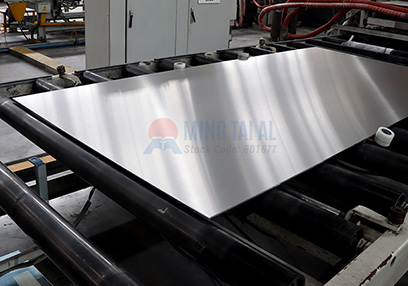
Pipeline jacketing in oil and gas service is more than an outer wrap. It must resist rain, salt spray, industrial atmospheres, and mechanical impact while protecting insulation and reducing corrosion under insulation risk. When evaluating whether 3003 aluminum sheet for Pipeline Jacketing is worth specifying, can replace more expensive materials, or meet compliance requirements, the key is not maximum strength but the best overall balance.
3003 is an aluminum-manganese alloy. Manganese raises strength while preserving good formability and weldability.
– Strength higher than pure aluminum, so jacketing resists foot traffic, wind vibration, and impact.
– Strength lower than 5052, but usually sufficient for jacketing.
– Non-heat-treatable, supplied in H14, H24, and other cold-worked tempers for stable performance.
– Moderate springback, making field rolling, bending, and crimping easier.
For pipeline jacketing, this combination of “strong enough, easy to form, cost-controlled” has more engineering value than chasing maximum strength.
Pipelines may run through coastal areas, refinery complexes, or inland temperature zones. 3003 naturally forms a dense oxide film, which provides good corrosion resistance in most atmospheric environments.
However, certain conditions require closer evaluation:
– Severe chemical exposure
– Special fire requirements
– High-humidity enclosed structures
In these cases, thickness and installation should be assessed per project specifications.
Note: Supply of 3003 jacketing substrate typically does not include aluminum coil surface treatment or further processing; those steps are generally handled downstream.
Under ASTM C1729, 3003 and 3105 are often considered interchangeable for jacketing. Differences:
– 3003 has higher manganese content, and its strength and oil & gas project track record are more common.
– 3105 is sometimes favored for recycled content and sustainability scoring.
– If a specification says “3003 or 3105,” 3003 is usually the safer designation.
This is not to say 3105 is unsuitable, but 3003 has broader specification acceptance and supply maturity for oil & gas pipeline jacketing.
– 5052: Higher strength and better marine salt-spray resistance, but higher cost and more springback, often unnecessary for jacketing.
– Stainless steel: Better for extreme corrosion or fire scenarios, but heavier, more expensive, and harder to fabricate and install.
– 3003: Best balance of performance, fabrication, and cost for most onshore oil & gas pipelines and refinery insulation.
So 3003 is often not a fallback but an engineering-validated default.
1. Alloy and temper: 3003, H14 or H24.
2. Standards: ASTM B209; jacketing material standard ASTM C1729; installation may reference ASTM C1879.
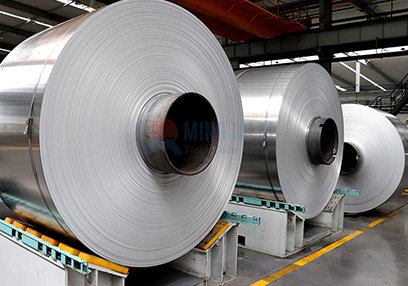
3. Dimensions: thickness, width, coil weight or sheet length per project specification.
4. Form: sheet or coil, whether fasteners or sealant tape are needed.
5. Environment: coastal, industrial atmosphere, high-temperature steam lines, etc., to help determine suitable thickness.
Providing this information at once leads to more accurate quotes and supply, and reduces later changes.
3003 forms easily, making field rolling, crimping, and bending easier to do correctly. Long-term performance depends on three key details:
1. Correct overlap
2. Proper fastener spacing
3. Safety hemming
In most industrial atmospheres, bare 3003 jacketing can remain maintenance-free for long periods. Periodic visual checks are sufficient—focus on:
– Mechanical damage
– Fasteners
– Seams
Mingtai Aluminum supplies 3003 Aluminum Sheet for Pipeline Jacketing meeting ASTM B209. Contact us for specifications and supply options.
Q: Are 3003 and 3105 jacketing interchangeable?
A: Under ASTM C1729 they are often considered interchangeable, but 3003 is more commonly specified in oil & gas.
Q: What temper is 3003 jacketing typically supplied in?
A: H14 or H24 half-hard temper is standard.
Q: Can 3003 jacketing be used in coastal environments?
A: Yes, with suitable thickness and proper installation and inspection.
Q: Does bare 3003 require painting?
A: In most onshore oil & gas environments, bare 3003 forms a natural oxide film and does not require painting; painted options are specified for special chemical or aesthetic needs.
Q: Do you provide surface treatment or further processing?
A: We supply 3003 aluminum sheet/coil substrate and do not provide aluminum coil surface treatment or further processing.