Stock code: 601677
Stock code: 601677
Choosing the right aluminum coil for curtain wall cladding affects weather resistance, flatness, and service life. If the material is poorly matched to the project, it may crack or deform during fabrication, or it may age faster than expected after installation. Replacing failed panels later usually costs far more than getting the specification right at the start. This guide covers three decision areas: alloy selection, specification matching, and quality checks.
Curtain wall aluminum coil usually comes from the 3xxx and 5xxx series, with 3003 and 5052 being the two most common choices.
– Excellent formability, suitable for bending and complex profiles
– Good corrosion resistance and cost efficiency
– Common tempers: H14/H24, suitable for inland projects
– Higher strength and better corrosion resistance than 3003
– Better suited to coastal or high-humidity environments
– Common tempers: H32/H34
– Inland, standard projects → 3003-H14/H24
– Coastal or high-corrosion environments → 5052-H32
– Higher structural strength → 6xxx series may be considered, but formability decreases
Curtain walls are exposed to UV, acid rain, temperature swings, and wind loads for years. The alloy and temper need to match the project’s corrosion, strength, and forming requirements. That is why alloy selection is the first step, not an afterthought.
Specification matching affects both fabrication equipment and curtain wall design.
– Thickness: Exterior curtain wall panels usually use a medium thickness range. Load-bearing panels should use a heavier gauge to maintain flatness and wind-load performance.
– Width: The coil width must match the unfolded panel size and the capacity of the roll-forming or coil-coating line. Wide curtain wall designs often require wider coils.
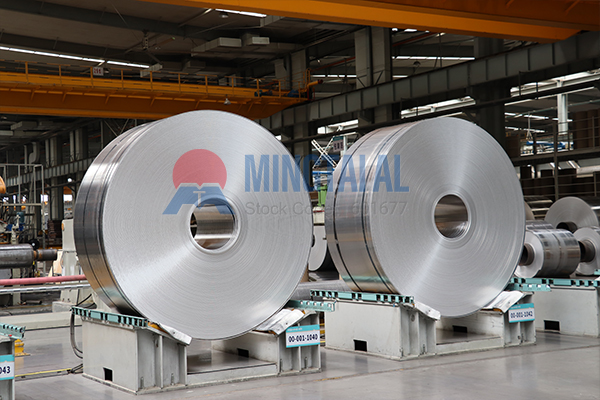
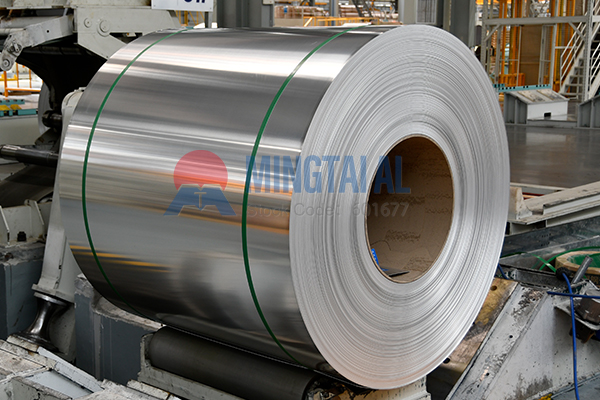
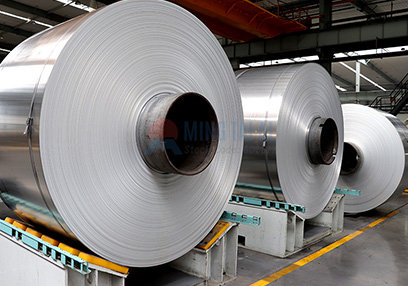
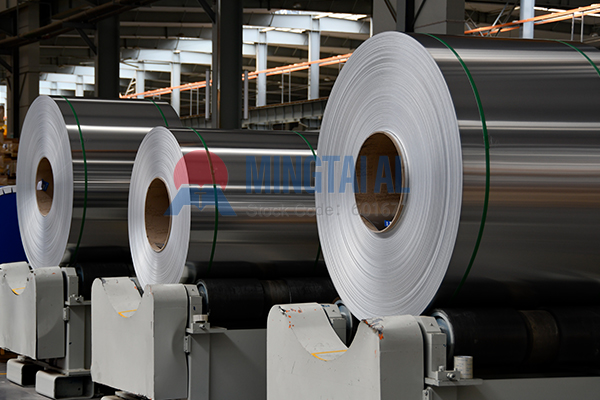
– Coil weight and inner diameter: These should be compatible with the downstream uncoiler so that feeding and processing run smoothly.
– Standards: It is advisable to specify standards such as ASTM B209, GB/T 3880, or EN 485, and to require a Mill Test Report (MTR) with each batch.
We focus on aluminum coil rolling and supply. We do not provide surface coating or downstream re-processing, so you can select the substrate that fits your own coating line.
For aluminum coil for curtain wall projects, flatness and thickness tolerance are especially important. Curtain walls demand high visual flatness, especially for large single panels and dark-coated sheets. If flatness problems are only discovered during fabrication, an entire batch may be unusable, and the loss is usually far greater than the material cost itself.
– Flatness: A qualified coil should be free from obvious indentation and residual stress, and should not deform easily after shearing. You can request samples for trial forming.
– Surface defects: Obvious marks, waves, scratches, and blisters are not acceptable. For uncoated substrate coils, also check for rolling streaks, oxidation color differences, and edge cracks.
– Thickness tolerance: This directly affects panel rigidity and flatness. The tolerance range should be clearly stated in the contract to avoid disputes at acceptance.
– Inspection: Third-party inspection or factory inspection can be used, focusing on consistency between the first and last coils. The MTR should include chemical composition, mechanical properties, and dimensional tolerance data.
Clear information before requesting a quote helps speed up the response and reduces rework caused by specification errors.
1. Confirm the alloy grade, such as 3003 or 5052, and whether another series is needed.
2. Define the temper, such as H14, H24, or H32, to match forming method and strength requirements.
3. Specify thickness and tolerance range to meet the panel design.
4. Provide width and inner diameter requirements to match existing processing equipment.
5. State the coil weight range for logistics and uncoiling.
6. Specify the standard, such as ASTM, GB, or EN.
7. Confirm whether an MTR and third-party inspection are required.
8. Discuss lead time and packaging requirements.
Q1: What is the most common alloy for curtain wall aluminum coil?
A: 3003-H14/H24 is the most common, offering a good balance of corrosion resistance, formability, and cost.
Q2: What thickness is typically used for curtain wall panels?
A: Exterior panels usually use a medium thickness range, and load-bearing panels should use a heavier gauge.
Q3: Can 3003 aluminum coil be used in coastal environments?
A: Yes, but 5052 or another Al-Mg alloy is recommended because it offers better salt-spray corrosion resistance.
Q4: How can I verify coil quality before placing a bulk order?
A: Request an MTR, order samples, and consider third-party inspection for flatness, thickness tolerance, and surface defects.
If your curtain wall project needs consistent flatness and traceable batches, Mingtai Aluminum supplies 3003, 5052, and other architectural alloys in wide coil widths, with an MTR for every batch. Contact us to discuss your specifications.