Stock code: 601677
Stock code: 601677
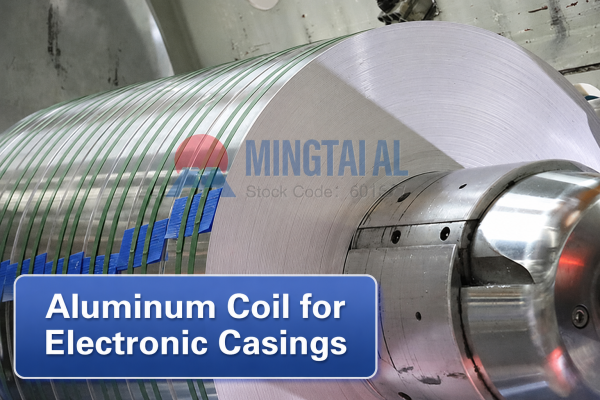
Selecting the right aluminum coil for electronic casings is not complicated, but it directly affects product quality and production efficiency. Electronic enclosures—such as those for routers, laptops, and power supplies—require materials that are lightweight, heat-dissipating, and easy to stamp. Aluminum coil ticks all these boxes. However, the real challenge lies in choosing the correct alloy, thickness, and flatness tolerance. Get it wrong, and you face stamping cracks, poor assembly gaps, or even overheating issues. Below we explain, from a practical viewpoint, how to choose the right material.
Aluminum offers several advantages that plastics or steel cannot fully match:
– Light weight – Density around 2.7 g/cm³, nearly one-third that of steel. Essential for portable devices.
– Heat dissipation – Thermal conductivity of 200–220 W/(m·K), quickly moving heat from chips to the casing surface.
– EMI shielding – Good electrical conductivity provides basic electromagnetic interference protection.
– Processability – Suitable for high-speed stamping, deep drawing, and bending, with long die life.
In addition, aluminum naturally forms an oxide layer in air, resisting corrosion for over a decade in normal indoor environments.
When buyers search for material, they usually focus on these three indicators rather than brand names.
Different alloys offer different strength and elongation. For deep drawing (depth >5mm), you need high elongation alloys like 1060 or 3003-O. For laptop casings that require impact resistance, 5052-H32 is better.
Electronic casings are typically 0.5–1.5mm thick. Loose tolerance leads to mismatched top and bottom covers or misaligned screw holes. For precision casings, aim for thickness tolerance within ±0.01–0.02mm.
Automated stamping lines feed coil continuously. If warpage exceeds 1mm per meter, the coil can jam in the feeding rollers, causing downtime. Many overlook this, but it is a hidden productivity killer.
The table below helps you quickly decide which alloy fits your application.
|
Alloy |
Characteristics |
Suitable Electronic Casing |
|
1060 |
Excellent ductility, best thermal conductivity |
LED heat sink housings, ultra-thin liners |
|
3003 |
Moderate strength, good weldability, cost-effective |
Set-top boxes, routers, general power supply casings |
|
5052 |
Higher strength, good fatigue resistance, corrosion resistant |
Laptop shells, ruggedized devices, outdoor enclosures |
|
5754 |
Stronger than 3003, low springback |
Industrial power supply housings, instrument cases |
A common search is “5052 vs 3003 for electronic housings” – simply put, 3003 is enough for ordinary casings; choose 5052 when higher strength or impact resistance is required.
Many buyers only ask for thickness and width, but ignore the following details, ending up with unusable material.
– Thickness range – Commonly 0.2–3.0mm, with 0.5, 0.8, 1.0, and 1.5mm being the most used.
– Width – Typically 100–1600mm. Choose slitting width according to your mold size to minimize waste.
– Coil weight – 2 to 8 tons per coil. Too small increases changeover frequency; too large may overload the uncoiler.
– Key tolerances:
– Thickness: ±0.01–0.02mm
– Width: ±0.5mm
– Camber (side bend): ≤2mm per 2000mm
A reliable supplier should provide a mill test report for each batch, focusing on three items:
1. Chemical composition – Compliant with GB/T 3190 or EN 573-3. Alloying elements must be within specified limits.
2. Mechanical properties – Tensile, yield strength, and elongation tested per coil (e.g., JIS Z 2241 or ASTM E8).
3. Surface quality – Visual and laser flatness inspection. No scratches, oil stains, dents, or corrosion pits.
For packaging, export-grade requires rust-proof paper + PE film + wooden pallet to prevent salt spray corrosion during sea freight. Domestic short-haul transport can be simpler, but moisture protection is still needed.
Projects vary widely in MOQ and lead time. Some require a small trial (1–2 tons); others consume hundreds of tons per month. A good supplier should offer:
– Stock of multiple alloys and tempers (O, H14, H32, H24, etc.) for shorter lead times.
– Slitting to your exact width, directly matching your mold to reduce secondary scrap.
– Edge trimming (deburring) to prevent operator injury and aluminum dust contamination in clean rooms.
Typical lead time for regular orders is 15–25 days. Small-batch samples can be arranged faster.
To sum up, choosing the right aluminum coil for electronic casings balances cost, performance, and production efficiency. Every parameter—from alloy to flatness—affects final reliability. For consistent quality and precise tolerances, Mingtai Aluminum supplies reliable coils tailored to your specs. Contact us for samples or a technical data sheet.
Q: What is the most common aluminum alloy for electronic casings?
A: 3003 and 5052 – 3003 is cost-effective, 5052 offers higher strength.
Q: What thickness is typical for a laptop casing?
A: 0.8mm to 1.2mm, balancing lightness and rigidity.
Q: What happens if the coil flatness is poor?
A: It may jam in the feeding rollers of automated stamping lines, causing frequent stoppages.
Q: What thickness tolerance should I require for precision casings?
A: ±0.01–0.02mm; for standard casings, ±0.03mm is acceptable.
Q: Can Mingtai Aluminum provide small trial quantities for a new project?
A: Yes, sample orders starting from 1 ton are available for qualification.