Stock code: 601677
A highway sign that remains flat, legible, and rust-free after years of outdoor exposure almost certainly uses 5052 H32 aluminum coil as its base material. For anyone sourcing aluminum coil for signboards, this alloy has become a widely recognized choice in the aluminum-magnesium family.
In short: it makes compliance and weather resistance the default.
– Widely accepted in mainstream specifications. In highway signage, 5052 H32 is one of the most commonly used alloys in the aluminum-magnesium family. Many highway authorities and traffic facility specifications list it as a designated or recommended base material.
– Smooth alignment with standards. 5052 H32 readily corresponds to common aluminum sheet and coil standards such as ASTM B209 and EN 485, making material acceptance straightforward for sign manufacturers and engineering teams.
– Lower acceptance risk. Choosing an industry-standard alloy reduces rework and communication costs caused by non-compliant material.
1. Corrosion resistance – determines how long a sign lasts.
5052 is an aluminum-magnesium alloy with magnesium content between 2.2% and 2.8%. The dense oxide film that forms on its surface performs well in humid, salt-spray, and industrial atmospheres. For coastal highways and high-humidity locations, this property is especially critical.
2. Balance of strength and formability – determines how smoothly fabrication runs.
5052 H32 has a moderate-to-high tensile strength while maintaining good ductility. It can handle routine sign-making operations such as bending, punching, and cutting without cracking or deforming. This means sign manufacturers do not need to adjust process parameters extensively.
3. Weldability – determines how easily structural parts can be made.
5052 H32 rates very good for both arc welding and resistance welding, making it suitable for large structural signs and custom-shaped panels.
More than one type of aluminum coil is used for signs. Selection involves balancing strength, corrosion resistance, and cost:
– 3003 H14: Lower tensile strength, better formability. Suitable for indoor signs or applications with lower strength requirements. Usually lower cost than 5052.
– 5052 H32: Significantly higher strength than 3003, better corrosion resistance, especially in saltwater environments. Suitable for outdoor highway signs and coastal signage.
– 5052 H34/H38: Higher strength still. Suitable for long-span highway signs and large structural signs.
If a sign needs to meet state or provincial transportation specifications or stay outdoors for many years, 5052 H32 is the priority option. For short-term or indoor signs, 3003 H14 can reduce material cost.
Start with sign size, then mounting method, and finally verify against local wind load specifications.
– Small signs: Width under 750 mm, aluminum thickness typically no less than 1.6 mm.
– Medium signs: Width between 750 mm and 1200 mm, thickness typically no less than 2.1 mm.
– Large highway signs and dynamic message signs: Higher thickness is required, often 3.0 mm or more. H34 or H38 temper may be needed for greater stiffness.
The Canadian government procurement specification provides the reference framework for the first two categories above. For actual selection, combine local wind load specifications with structural calculations from the sign designer.
The following checklist can help you verify details before ordering:
1. Material certificate: Ask the supplier for an MTC (Mill Test Certificate) to confirm alloy grade, temper, and chemical composition meet ASTM B209.
2. Thickness tolerance: Confirm the tolerance range. Typically, thin sheet (≤1 mm) has a tolerance of ±0.02 mm, while thicker sheet uses ±1% of thickness.
3. Surface quality: Check for scratches, oxidation discoloration, coil marks, pinholes, and other defects—these directly affect reflective film adhesion.
4. Width and coil weight: Confirm the aluminum coil width range, inner diameter, and single coil weight match your processing equipment.
5. Compliance documents: Confirm whether SGS/BV third-party inspection reports or specific industry certifications are needed for your target market.
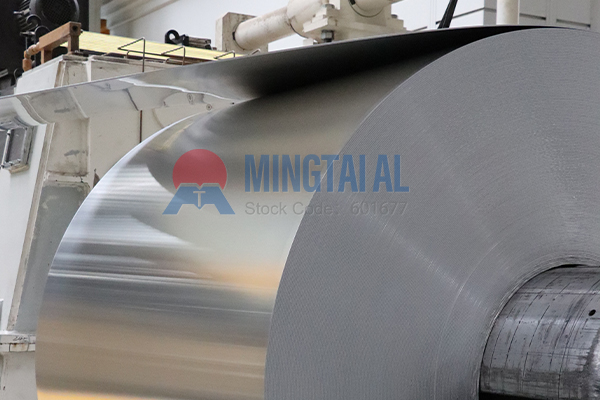
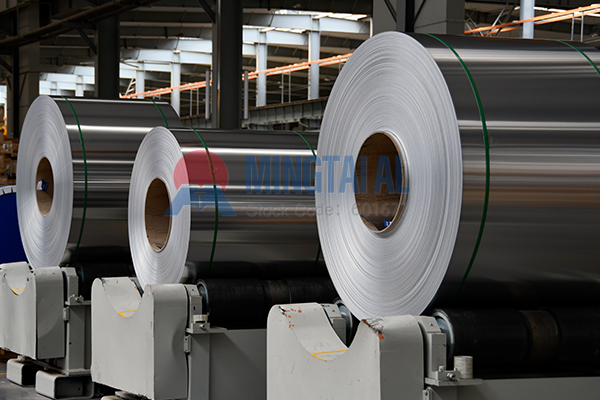
The aluminum coil above is supplied in mill finish. Surface treatment, cutting, bending, and other re-processing steps are completed by the sign manufacturer.
Q: What temper is 5052 aluminum coil for signboards usually supplied in?
A: H32 is the most common choice, offering a good balance of strength and formability.
Q: Can 5052 H32 aluminum coil be welded?
A: Yes. 5052 H32 has very good arc and resistance weldability, suitable for sign structure welding.
Q: What is the difference between 5052 H32 and 3003, and how to choose?
A: 5052 offers higher strength and better corrosion resistance for outdoor highway signs; 3003 is more economical and easier to form for indoor or light-duty signs.
Q: What standards should be confirmed before ordering?
A: At minimum, confirm the product meets ASTM B209, and request a material certificate and third-party test reports as required by the project.
Mingtai Aluminum supplies 5052 H32 aluminum coil in mill finish, with custom width and thickness options. The product meets ASTM B209 and comes with a material certificate. For specifications and pricing, please contact our team.