Stock code: 601677
Stock code: 601677
Aluminum sheet for automotive heat shields may look like a simple flat part, but a drawing that says only “aluminum sheet” leaves a key decision open. 1050 and 3003 are both aluminum sheet grades, yet they differ in heat reflection, forming window, stiffness and corrosion behavior. The key is not to find a “stronger” grade, but to match the material to the heat zone, geometry and service environment.
– 1050: a commercially pure aluminum grade with a good purity base, useful for radiant heat reflection when the surface condition is right; it offers a wide forming window for embossing, deep drawing and more complex contours; cost is usually more favorable.
– 3003: an aluminum-manganese grade with better strength and stiffness, and usually slightly better corrosion resistance; it suits larger heat shields with fewer support points, noticeable vibration or wet exposure; it still forms well, but complex forming needs more attention to springback and tool compensation.
Neither grade is a universal sheet. Final heat-shield performance also depends on surface state, thickness, air gap and mounting method.
If the main job is to reflect radiant heat rather than carry mechanical load, 1050 is often the more direct route.
– Wide forming window: complex embossing, wrapping around irregular contours and small-radius forming are easier to move forward.
– Lower trial-and-error risk: the softer grade gives more room in tooling and process setup.
– Low weight: aluminum’s low density helps keep part weight down.
One boundary is worth watching: if the part must hold its own shape, resist vibration fatigue or carry assembly loads, the lower strength of 1050 needs a second look. At that point, do not compare grade names alone; look at how the part is actually loaded.
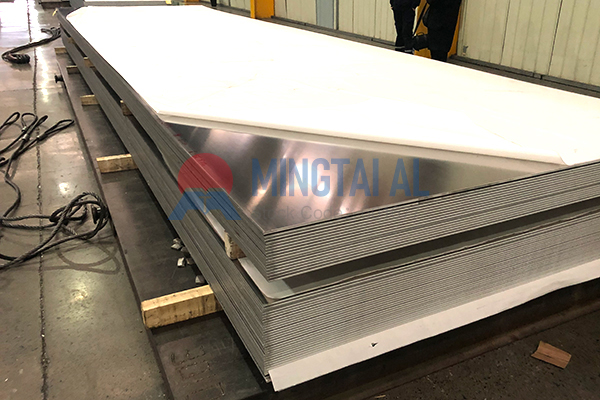
Mingtai Al supplies 1050 and 3003 aluminum sheet coils as base material, with temper, thickness and flatness as the main delivery requirements; surface treatment and further processing are handled downstream.
The value of 3003 is not “better insulation.” It is structural margin alongside heat shielding.
– Large panels with fewer supports: higher strength and stiffness help the part keep its shape.
– Vibration exposure: better resistance to deformation under repeated movement.
– Road splash and road salt: its corrosion margin is useful in chassis-area heat shields.
Its forming behavior covers most heat-shield geometries. In deep drawing or complex embossing, however, the process window is less forgiving than 1050.
If the higher strength of 3003 is used to optimize thickness, validate forming behavior and thermal performance together. Do not set thickness from strength alone.
If it must resist deformation and vibration on its own, lean toward 3003; if it is attached to or hung from an existing support, the forming and cost advantages of 1050 are more direct.
With radiant heat, surface reflection carries more weight; when the heat source is close and conduction is steady, consider thickness, air gap and overall thermal management together.
Deep drawing, complex embossing and wrapping irregular contours are easier with the forming window of 1050; with flat panels and bends, the stiffness advantage of 3003 is easier to realize.
A dry engine-bay heat zone differs from a chassis area with splash and road salt; in the latter, the corrosion margin of 3003 deserves more weight.
There is no “better” grade in isolation, only a better match. Treating the alloy grade on the drawing as a deliberate choice—not a default—helps reflection, forming and service stability work together.
Q: Which grade performs better for heat shielding?
A: Both can work well with the right surface condition, and final performance depends more on surface state, thickness and air-gap design.
Q: Can 3003 be made thinner to save weight because it is stronger?
A: It can be evaluated, but thinning changes forming behavior and heat capacity, so the process window and thermal performance need to be rechecked.
Q: Do polishing or embossing need to be specified when buying the base material?
A: Start with alloy, temper and thickness for the base material; polishing, embossing and other surface states are handled downstream.
For Aluminum Sheet for Automotive Heat Shields, Mingtai Aluminum supplies 1050 and 3003 coils and can match base material temper and thickness to the heat zone and forming method. Share the part dimensions and service conditions to confirm a suitable specification.