Stock code: 601677
Stock code: 601677
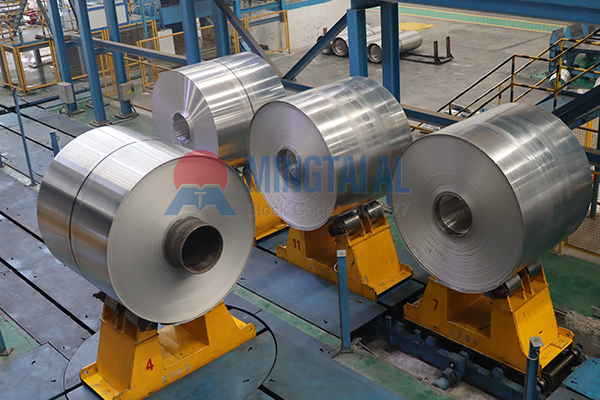
Among aluminum flat products, the 2.5mm 5052 aluminum coil offers a practical middle ground – stiffer than thin sheets, yet easier to form than heavy plates. Thanks to its excellent corrosion resistance and weldability, this alloy is a go‑to choice for many industrial users. Below you will find technical data, real‑world applications, and key buying tips.
– Thickness: 2.5 mm (tolerance usually ±0.05–0.10 mm, per ASTM B209 or GB/T 3880)
– Width: 200 mm up to 1650 mm, slitting available
– Common tempers: H32 (stabilized, good strength and formability), H34 (half‑hard, higher strength), O (annealed, for deep drawing)
– Coil inner diameter: 405 mm or 505 mm
– Weight per meter: approx. 6.78 kg for 1000 mm width
Always confirm the temper and tolerance range before ordering.
|
Property |
Value |
|
Tensile strength |
210–260 MPa |
|
Yield strength |
≥130 MPa |
|
Elongation (50 mm gauge) |
≥12% |
|
Hardness (HB) |
~60 |
|
Density |
2.68 g/cm³ |
5052 is a non‑heat‑treatable Al‑Mg alloy. Compared to 6061, it has slightly lower yield strength but better elongation and corrosion resistance – especially important after welding, where it retains about 90% of base metal strength.
Different industries choose this material for different reasons:
– Marine & offshore: fuel tanks, bulkheads, ventilation ducts, deck structures (excellent seawater resistance)
– Automotive & transport: fuel tanks, interior panels, sound shields, anti‑slip plates – 2.5 mm gives impact strength without adding much weight
– Electronics & communication: outdoor cabinets, battery enclosures, heat sink backplates (good formability and thermal conductivity)
– General industry: pressure vessels (non‑ASME), pipe cladding, tanks, fixture plates
– Building & curtain walls: back panels for composite sheets, louvers – the 2.5 mm thickness provides enough rigidity to avoid deformation
Many buyers ask: “Should I use 5052 or 6061?” Here is a quick guide.
– 5052 vs. 6061: 5052 bends better, resists seawater corrosion more effectively, and has less softening in the weld heat‑affected zone. 6061 can be heat treated (T6 gives higher strength) but may distort after machining.
→ Choose 5052 for high corrosion resistance + complex forming.
→ Choose 6061 for high load‑bearing + heavy machining.
– 5052 vs. 5083: 5083 is stronger (tensile ≥290 MPa) but less ductile in cold bending. At 2.5 mm thickness, 5052 is easier to brake‑form and stamp. 5083 suits high‑pressure tanks.
– 5052 vs. 3003: 5052 is stronger and more corrosion‑resistant, though slightly more expensive. For long‑lasting applications, 5052 is the upgrade.
To avoid problems, check these items:
1. Temper and tolerance – Write the exact temper (H32/H34/O) and thickness standard in your contract.
2. Width and slitting – Does the supplier offer narrow slitting? Minimum order quantity is usually 3–5 tons.
3. Surface and edge quality – Standard mill finish (no oil, no scratches), clean cut or milled edges (no burrs).
4. Certifications & reports – Request a material test certificate (MTC) confirming ASTM B209 or GB/T 3880.
5. Packaging & shipping – Vertical or horizontal moisture‑proof packaging; fumigated pallets for export.
The 2.5mm 5052 aluminum coil balances corrosion resistance, moderate strength, formability and weldability – a mature choice for marine, automotive, and electronic applications.
Mingtai Aluminum supplies stable 2.5mm 5052 aluminum coils with precise gauge control and full mill certifications. For volume orders, rely on Mingtai’s consistent quality and on‑time delivery.-
Q1: What is the most common temper for 2.5mm 5052 coil?
A: H32 – it offers the best balance of strength and formability for most industrial uses.
Q2: Can this coil be used in seawater environments?
A: Yes, 5052 has excellent seawater corrosion resistance and is widely used for marine fuel tanks and bulkheads.
Q3: Which welds better – 5052 or 6061?
A: 5052 shows less strength loss in the heat‑affected zone and fewer cracks, so it is generally considered better for welding.
Q4: What is the typical minimum order quantity for 2.5mm 5052 coil?
A: Most suppliers require 3–5 tons, but it can vary with width and coil weight.
Q5: What certifications should I ask for when buying this coil?
A: Confirm compliance with ASTM B209 or GB/T 3880 and request a material test certificate (MTC).