Stock code: 601677
Stock code: 601677
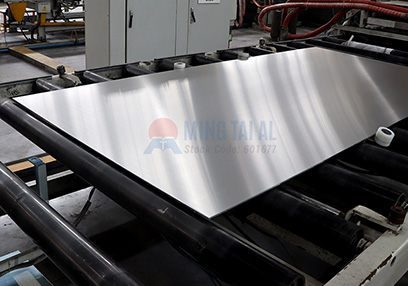
In the manufacturing of efficient heat exchangers, clad aluminum sheet for brazing has become an indispensable key material in industries like automotive and refrigeration. This product is a precision-engineered composite. It typically uses an aluminum-manganese alloy like 3003 as the core, providing structural strength and formability. On both sides of this core, a functional cladding layer of 4343 aluminum alloy—with a silicon content of approximately 7.5%—is metallurgically bonded. During controlled atmosphere furnace brazing (such as the widely used NOCOLOK® process), this 4343 aluminum brazing sheet cladding melts at a specific temperature. It flows precisely to fill joints, creating strong, leak-tight metallurgical bonds between components.
This material offers a unique combination of benefits essential for reliable performance.
* Excellent Brazability: The cladding has a suitable melting range. It flows and spreads evenly during brazing, thoroughly wetting the base metal. This creates smooth, dense fillets, which are critical for achieving airtight seals and long-term reliability in heat exchangers.
* Strong Corrosion Resistance: The brazed joints and the overall assembly demonstrate good resistance to corrosion. They can withstand exposure to humid environments, automotive coolants, and various chemicals, ensuring a long product lifespan.
* Favorable Mechanical Properties: The core material maintains a good balance of strength and ductility. Supplied in an annealed (O-temper) state, it allows for complex shaping through stamping or drawing. After brazing, the material’s strength is restored or enhanced to meet structural and pressure requirements.
This versatile material is fundamental to two major sectors.
* Automotive Thermal Management: It is the core material for lightweight and efficient systems. It is extensively used to manufacture radiators, intercoolers, oil coolers, and for new energy vehicles, battery cooling plates, condensers, and evaporators. Its reliable brazing performance is the foundation for compact, high-performance heat exchanger designs.
* HVAC&R Industry: This is the primary choice for manufacturing parallel-flow microchannel heat exchangers. These are found in residential AC units, commercial refrigeration, and data center cooling systems. The material’s high thermal conductivity and consistent brazing quality directly contribute to higher energy efficiency and equipment reliability. It is also used in power plant cooling and industrial heat recovery units.
Choosing the right brazing sheet involves several key engineering considerations beyond just the alloy designation.
* Specifications: Determine the required thickness, width, and temper (usually O-temper) based on the final part design.
* Clad Ratio: This refers to the thickness of the cladding layer on each side as a percentage of the total sheet thickness (e.g., 5%-15% per side). It controls the amount of filler metal available. Too little may cause weak joints; too much can lead to erosion.
* Consistent Quality: This is critical for high-volume manufacturing yield. Focus on:
* Precise chemical composition for consistent brazing performance.
* Tight dimensional and flatness tolerances for smooth automated stamping and assembly.
* Superior surface quality—free from excessive oil, scratches, or oxidation—which is essential for achieving defect-free braze joints.
* Supplier Capability: Selecting a producer with strong expertise in alloy casting, precision rolling technology, and a complete quality control system is fundamental for obtaining material with stable, batch-to-batch consistency.
At Mingtai Aluminum, we specialize in manufacturing aluminum plate, sheet, and foil. We have built deep expertise in brazing materials. We understand that high-quality clad sheet is the starting point for our customers’ excellent products. Therefore, we are committed to:
* Delivering products with exceptional and highly stable performance through advanced melt purification, homogenization, and precise rolling processes.
* Ensuring accurate specifications and meeting stringent tolerances for thickness, width, clad ratio, and flatness to support automated production lines.
* Upholding strict quality control from raw material to finished product, supported by test certificates compliant with ASTM, EN, GB, and other major standards.
Q1: What is the main composition of this brazing sheet?
A1: The cladding (filler layer) is an aluminum-silicon alloy with ~7.5% Si. The core is typically an aluminum-manganese alloy like 3003, providing the main strength and formability.
Q2: What are the common thickness ranges?
A2: For automotive and HVAC heat exchangers, common thicknesses range from 0.15mm to 1.5mm, depending on specific part designs like tubes or fins.
Q3: Is Mingtai’s product suitable for flux-free brazing?
A3: Yes. Our material is specifically designed and produced for Controlled Atmosphere Brazing (CAB) processes using non-corrosive fluxes like NOCOLOK®, enabling clean and efficient joining.
Q4: Do you provide technical data sheets (TDS)?
A4: Yes. We provide detailed TDS for each batch and can supply relevant material certification upon request to support your production and quality management.