Stock code: 601677
Stock code: 601677
Selecting the right aluminum sheet for structural applications goes beyond just ordering “a sheet of aluminum.”
If the alloy, temper, or thickness does not match your design, you may face bending failures, welding cracks, or unnecessary cost overruns.
Structural parts demand clear specifications for strength, corrosion resistance, weldability, and dimensional stability.
This guide walks you through four key decision points: alloy, thickness, temper, and procurement essentials – so you can make informed choices with confidence.
Not all aluminum alloys are created equal. Here is what each series offers:
– 1xxx (pure aluminum) – excellent formability but low strength; not suitable for load‑bearing parts.
– 3xxx (e.g., 3003) – moderate strength and good formability; often used in light‑duty panels and HVAC components.
– 5xxx (5052 / 5083 / 5454) – work‑hardened alloys that gain strength without heat treatment.
– 5052 is a common choice for marine and outdoor environments.
– 5083 retains high strength after welding, making it ideal for large welded structures.
– 5454 offers a balanced combination of strength, corrosion resistance, and weldability – widely used in tankers, pressure vessels, and offshore engineering.
– 6xxx (6061 / 6082) – heat‑treatable alloys, the workhorses for structural applications.
– 6061 provides excellent overall performance and machinability.
– 6082 delivers higher load‑bearing capacity, suitable for heavy‑duty frames and long‑span structures.
– 7xxx (e.g., 7075) – the highest strength among aluminum alloys, but with lower formability and corrosion resistance, and higher cost. Typically reserved for aerospace and critical safety components.
The correct thickness must be calculated based on actual load and support conditions. Too thin – risk of deflection or failure; too thick – added weight and cost without benefit.
On engineering drawings, always specify dimensions in millimeters or inches – never rely on gauge numbers alone, as aluminum gauge differs from steel gauge.
Also note that the thickness refers to the base metal, excluding any coating or lamination.
– O‑temper (annealed) – softest, ideal for deep drawing, but cannot be strengthened afterwards; use with caution for structural parts.
– H‑temper (strain‑hardened) – higher numbers mean higher strength but lower ductility; suitable for moderate‑strength formed parts.
– T‑temper (heat‑treated, e.g., T6) – solution treated and artificially aged; designed for 6xxx and 7xxx alloys where high strength is required.
> Swapping tempers without approval can be disastrous – 6061‑T6 and 6061‑O have completely different mechanical properties.
When requesting quotes, do not stop at alloy and size. Make sure the following items are clearly stated in your purchase order:
– Thickness tolerance – actual thickness variations can cause assembly issues or localized weakness.
– Flatness / surface levelness – especially important for large welded or assembled structures; poor flatness affects fit‑up and final accuracy.
– Material test certificates – ask for certified mill test reports that comply with ASTM or EN standards – this is your guarantee of performance.
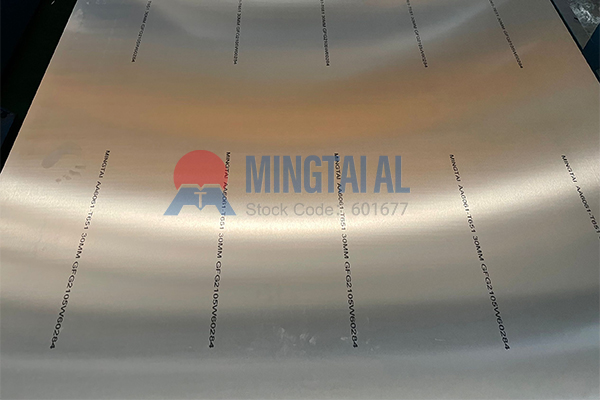
A complete specification example: `6061‑T6‑2.0 × 1200 × 2400 mm`. Avoid vague descriptions like “high‑strength aluminum sheet.”
Thanks to its light weight (about one‑third the density of steel), excellent corrosion resistance, and high recyclability, aluminum sheet is widely adopted in:
– Transportation – automotive crash beams, battery trays, truck frames, railcar bodies
– Building & construction – curtain‑wall mullions, bridge components, roof trusses
– Industrial equipment – machine bases, robotic arms, precision apparatus frames
– Marine & offshore – hull structures, decks, platform components
– Pressure vessels – tank shells, heads, baffle plates
In all these cases, the material must be specified with exact alloy, temper, and tolerance – not just “structural aluminum.”
Material compliance is the baseline, but supplier reliability also determines your project success. Consider batch‑to‑batch consistency, delivery capability, and multi‑standard certifications (ASTM, EN, GB) for international shipments.
A supplier with integrated production – from melting to final rolling – can better control quality and ensure stable mechanical properties across orders.
For reliable supply of aluminum sheet for structural applications, Mingtai Aluminum offers full‑chain production covering all 1‑8 series alloys, delivering consistent quality for your structural projects.
Q: Should I choose 6061 or 6082 for structural use?
A: 6061 is suitable for general purposes; choose 6082 when higher load capacity or rigidity is required.
Q: How do I determine the right thickness safely?
A: Calculate the required section modulus based on actual loads, and specify thickness in mm or inches – never rely on gauge numbers alone.
Q: Which series has better weldability – 5xxx or 6xxx?
A: 5xxx (especially 5083) maintains strength after welding, making it more weld‑friendly; 6xxx can be welded but the heat‑affected zone softens, so design accordingly.
Q: What is the most overlooked specification during purchasing?
A: Thickness tolerance and flatness – if not defined, the received material may fail to assemble or affect structural stability.