Stock code: 601677
Stock code: 601677
When buying aluminum sheet, have you ever wondered what “meets standard” really means? Why does the same alloy from different suppliers perform so differently?
The answer often lies in one key document: the ASTM B209 aluminum sheet specification. Today, we break down this global standard to help you make smarter purchasing decisions.
ASTM B209 is the standard specification for aluminum and aluminum-alloy sheet and plate, developed by ASTM International. Simply put, it defines what aluminum sheet should look like and how it should perform.
In international trade, this standard acts as a “passport” for aluminum sheet. It sets strict rules for chemical composition, mechanical properties, and dimensional tolerances. Thanks to this standard, the same alloy from different manufacturers can be counted on to perform similarly.
If your products are for export or high-end manufacturing, sourcing materials that meet the astm b209 aluminum sheet specification is the first and most critical step.
To understand this standard, focus on three key areas:
This is the “identity” of your aluminum sheet. ASTM B209 covers several common alloy series:
– 1xxx Series (like 1060, 1100): Pure aluminum. Excellent conductivity and corrosion resistance. Used in chemical equipment and electronic parts.
– 3xxx Series (like 3003): Manganese alloy. Stronger than pure aluminum. Ideal for chemical tanks and building facades.
– 5xxx Series (like 5052, 5083): Magnesium alloy. Great weldability and seawater corrosion resistance. The top choice for ships and fuel tanks.
– 6xxx Series (like 6061): Magnesium-silicon alloy. Heat-treatable for high strength. Widely used in structural parts.
The standard also specifies “temper” (the material’s condition). Examples include O temper (annealed, softest), H14 (work-hardened, medium strength), H32 (stabilized, good for forming), and T6 (solution heat-treated and artificially aged, high strength).
This is often overlooked by buyers. ASTM B209 has strict rules for thickness, width, length, and flatness.
For example, for a 0.5mm thin sheet, the standard requires thickness tolerance within ±0.05mm. If you buy non-standard material, inconsistent thickness can ruin your fabrication process.
Harder isn’t always better. ASTM B209 sets minimum requirements for tensile strength, yield strength, and elongation for each alloy and temper.
Take 5052-H32 aluminum sheet. The standard requires a minimum tensile strength of 215 MPa. This data tells you if the material will bend or break under load.
If you are familiar with the Chinese standard (GB/T 3880) or the European standard (EN), you might think they are all the same. They are similar, but key differences exist:
– Vs. GB/T 3880: The Chinese standard was developed with reference to ASTM, so core requirements are close. However, ASTM uses imperial units (inches), while GB/T uses metric (millimeters). Export orders usually require the ASTM standard.
– Vs. EN Standards: European standards sometimes emphasize safety factors more, with slightly higher requirements for certain mechanical properties. But ASTM has wider global acceptance, especially in North America and Southeast Asia.
Mistake 1: “As long as the alloy is right, the standard doesn’t matter.”
This is the biggest trap. A “3003 aluminum sheet” that meets ASTM standards has guaranteed chemical consistency and strict impurity control. Non-standard materials may cut costs by using off-spec chemical compositions, leading to welding cracks or poor corrosion resistance.
Mistake 2: “ASTM B209 only covers dimensions, not chemistry.”
Wrong. The standard sets strict limits on impurities like silicon, iron, and copper. For 1100 alloy, copper must be between 0.05% and 0.20%. Outside that range, it is not qualified 1100.
Mistake 3: “A mill certificate is all I need.”
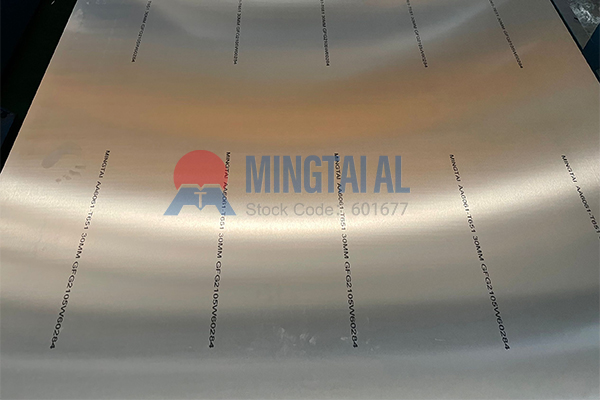
A certificate is necessary, but you must read it. A valid ASTM B209 mill certificate must clearly state: the specific standard version (e.g., ASTM B209-21), the alloy and temper, chemical analysis results, and mechanical test results. If information is missing, be cautious.
Q: Does ASTM B209 distinguish between sheet and plate? What is the limit?
A: Yes. Material up to 6.3mm thick is generally called sheet. Material 6.4mm and thicker is called plate. Tolerance standards and testing requirements differ slightly between the two.
Q: Can I order non-standard sizes?
A: Yes. ASTM B209 specifies tolerance ranges, not mandatory dimensions. As long as the supplier’s mill capacity allows, you can customize width and length.
Q: Does the standard require specific surface finishes?
A: It requires general quality – no cracks, deep scratches, or inclusions. However, specific surface finishes (like mirror finish) must be agreed upon between buyer and supplier. The standard itself does not mandate them.
Q: How do I read the temper designation on a certificate?
A: It’s simple. Take “5052-H32” as an example. H32 means “work-hardened and then stabilized.” This material is suitable for parts that need vibration resistance and moderate forming.
Choosing aluminum sheet that meets the ASTM B209 aluminum sheet specification means choosing reliability for your projects. Mingtai Aluminum strictly follows this international standard. Every batch comes with a traceable mill certificate, helping you meet the demands of high-end manufacturing and export.