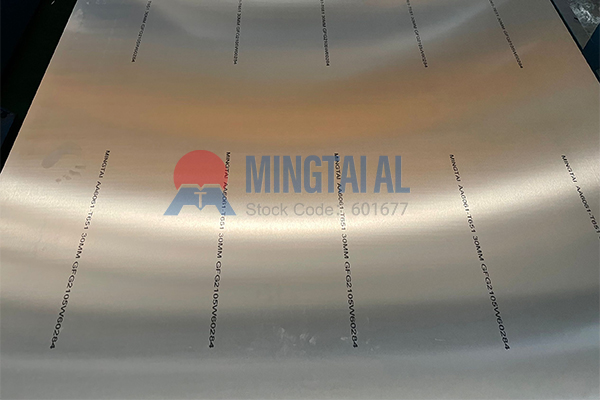
Stock code: 601677
Stock code: 601677
In global aluminum sheet trading, standards serve as the common language. Among the most frequently encountered are ASTM B209 and EN 485 – the American and European technical specifications for aluminum plate and sheet. While both define technical requirements, their differences are real. Overlooking them can lead to risks in order execution, from dimensional rejection to insufficient mechanical properties, or even customs clearance issues at the destination port. This article avoids dense regulatory text and focuses on practical insights to help you make more confident decisions when placing your next order.
– ASTM B209 – issued by ASTM International. It is widely accepted across the Americas, Southeast Asia, and many other regions. Think of it as a “common language” for general international trade.
– EN 485 – issued by the European Committee for Standardization. If your final project or delivery point is in Europe, this standard is often mandatory – it is your “technical passport” to enter that market.
> In short: for European business, EN 485 is unavoidable; for other international destinations, ASTM B209 is more common. But always confirm with your order party before proceeding.
Take 5052-H32 as an example. The two standards set slightly different requirements for tensile strength, yield strength, and elongation. Notably, EN 485 often asks for a slightly higher elongation value.
What this means for your operation:
If your downstream process involves bending, stamping, or deep drawing, material ordered to EN 485 may offer a lower risk of cracking. If your final product demands higher rigidity, pay extra attention to the tensile strength figures.
(We focus on supplying high-quality aluminum sheet blanks that meet various mechanical requirements. We do not perform surface treatment or secondary processing, so you have full flexibility to choose your own finishing route based on your specific needs.)
Thickness and width tolerances are where many order discrepancies arise. For the same nominal thickness (e.g., 2.0 mm), the allowed positive/negative deviation range can differ between the two standards.
Practical suggestions:
– If your tooling or fixtures are designed to one standard, double‑check compatibility when switching to the other.
– For high‑precision applications, always specify both the standard name and the exact tolerance requirement in your enquiry – not just the nominal thickness.
Naming conventions differ, but most common alloys have clear equivalents:
|
Common application |
ASTM B209 |
EN 485 |
|
General industrial pure aluminium |
1050, 1060 |
EN AW‑1050A, EN AW‑1060 |
|
General fabrication |
3003 |
EN AW‑3003 |
|
Medium‑strength structures |
5052 |
EN AW‑5052 |
|
Heat‑treatable structural parts |
6061 |
EN AW‑6061 |
This table helps you quickly translate the requirement into the correct designation under either standard – saving back‑and‑forth communication.
– Scenario A: Finished goods destined for Europe → Strictly follow EN 485. Your MTC (mill test certificate) must clearly state this standard; otherwise, customs clearance may be blocked.
– Scenario B: Supplying to downstream fabricators (stamping, bending, welding) → Do not rely on the standard name alone. Focus on elongation and thickness tolerance – these directly affect your process stability and yield rate. For demanding projects, consider ordering material that meets both standards simultaneously (dual‑certified).
– Scenario C: General industrial use or export to Americas, Southeast Asia, or the Middle East → ASTM B209 is typically more acceptable, but always get written confirmation from the receiving party.
MTC format and content requirements
Under EN 485, the MTC usually demands more detailed test records – for example, chemical composition per heat and mechanical properties per coil. ASTM B209 allows a slightly simpler certificate format.
What to do: Before signing the contract, ask the end user about the specific MTC format required by their local customs or final inspection. This avoids demurrage or return risks caused by documentation mismatches.
Temper codes like “O”, “H18”, and “T6” are generally consistent across both systems, but the actual process windows and resulting property ranges may have minor differences. To avoid ambiguity, always state the full specification – e.g., 5052‑H32 per ASTM B209 or EN AW‑5052‑H32 per EN 485 – in your purchase order.
Neither standard is inherently superior – it all depends on your specific application and destination. Clear awareness and precise communication are the foundations of efficient procurement. Before your next enquiry, take a moment to confirm three things: Where is the material going? What will be done to it? Does the end user have any special MTC requirements? Answering these upfront will make your sourcing decisions much more straightforward.
And when you need to decide between ASTM B209 and EN 485, remember that choosing a supplier with experience in both can save you significant time and risk.
For global aluminium trade, working with a supplier who can flexibly meet both ASTM B209 and EN 485 is a clear advantage. Henan Mingtai Aluminum has extensive export experience and can supply high‑quality aluminium sheet blanks that comply with either standard – helping you handle diverse overseas orders with confidence.
Q: For an order going to Germany, which standard should I choose?
A: EN 485 is mandatory, and your MTC must state that standard for customs clearance.
Q: If no standard is specified by the order party, which one is safer to recommend?
A: Always ask about the destination and use; for general exports, ASTM B209 is widely accepted, but get written confirmation.
Q: Is “O” temper exactly the same under both standards?
A: The concept is the same (fully annealed), but minor differences in residual hardness and elongation may exist – so specify clearly.
Q: Can I request material that meets both standards simultaneously?
A: Yes – you can ask for “dual‑certified” material; experienced mills can produce to the tighter requirements and provide certificates for both.