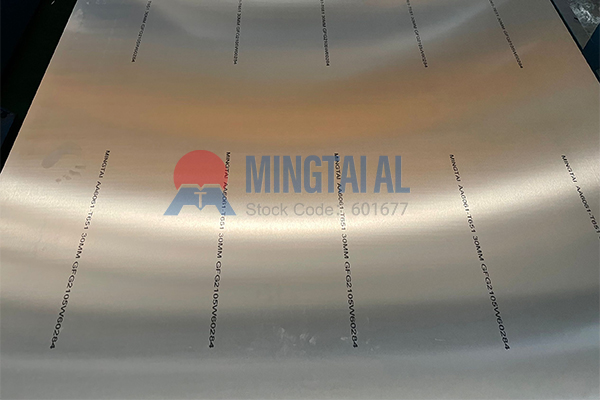
Stock code: 601677
Stock code: 601677
Does aluminum rust? That is often the first question when people consider a corrosion resistant aluminum sheet. The truth is, aluminum does not rust like steel—it naturally forms a dense oxide film that blocks moisture and oxygen. Even if scratched, this film quickly “self-heals.” But the real level of corrosion resistance does not depend solely on that film; it depends on the alloy composition. Choose the wrong alloy, and even a thick plate will fail within a few rainy seasons.
The oxide layer is stable in most everyday environments. However, in chloride‑rich conditions (seawater, salt spray) or strong acids/alkalis, the film can break down locally and cause pitting. That is why matching the alloy to the actual service environment is the first and most critical decision.
– 1xxx series (e.g., 1060) – pure aluminum with excellent corrosion resistance and the cleanest oxide film. But strength is low, so these are best for non‑load‑bearing uses like chemical liners or decorative panels.
– 3xxx series (e.g., 3003) – manganese is the main addition. These alloys offer good atmospheric corrosion resistance, plus excellent formability and weldability. They work well for roofing, siding, heat exchangers, and tanks in general industrial settings—great value for money.
– 5xxx series (the workhorse for corrosion resistance) – magnesium is the key element.
– 5052 (~2.5% Mg) provides outstanding resistance to salt spray and seawater, making it the most widely used anti‑corrosion alloy. Typical uses: marine sheet metal parts, automotive fuel tanks, bus skins, and chemical storage tanks.
– 5083 (~4.5% Mg) delivers top‑tier resistance to seawater, ideal for fully submerged marine structures and hull components.
– 5754 (also Al‑Mg) balances corrosion resistance, weldability, and formability—commonly found in shipbuilding, auto body panels, chemical pressure vessels, and offshore structures.
– 6xxx series (e.g., 6061) – magnesium and silicon allow heat treatment for higher strength than 5xxx, but corrosion resistance is slightly lower. Suitable for building frames and mechanical structures where strength matters more than extreme corrosion exposure.
> Important note: 2xxx (copper‑bearing) and 7xxx (zinc‑bearing) high‑strength alloys have poor corrosion resistance. Unless specially treated, they are not recommended for corrosive environments.
|
Environment |
Recommended Series |
Typical Grades |
|
Indoor / dry conditions |
1xxx, 3xxx |
1060, 3003 |
|
Outdoor humid / industrial atmosphere |
3xxx, 5xxx |
3003, 5052 |
|
Coastal / salt spray areas |
5xxx |
5052, 5083, 5754 |
|
Full seawater immersion / hull structures |
5xxx (high‑Mg) |
5083 |
|
Automotive fuel tanks / structural parts |
5xxx |
5052 |
|
Chemical tanks / piping |
5xxx |
5052, 5754 |
|
Building facades / decorative panels |
3xxx, 5xxx |
3003, 5005 |
– “All aluminum sheets have the same corrosion resistance.” – Wrong. The difference in salt‑spray life between 1xxx and 5xxx can be several times. Misidentification is the number one cause of premature failure.
– “Aluminum never corrodes, so any grade works anywhere.” – Not true. Chlorides (seawater, de‑icing salts) and strong chemicals attack the oxide film. Using anything other than 5xxx in marine projects is a gamble.
– “Thicker means more corrosion‑resistant.” – False. Corrosion performance depends on alloy chemistry and oxide quality, not thickness. Thickness only affects structural strength.
For ordinary outdoor use, 3003 is a cost‑effective choice. If the project involves coastal, marine, chemical, or salt‑spray conditions, go straight to the 5xxx family—5052 covers most needs, and 5083 handles the harshest challenges. Whichever you choose, always verify the exact grade and its proven performance in your specific environment. A reliable corrosion resistant aluminum sheet starts with the right alloy, not just the right price. Mingtai Aluminum supplies dependable corrosion resistant aluminum sheet across 1xxx‑6xxx series.
Q: Will a corrosion resistant aluminum sheet never rust?
A: It won’t rust like steel, but pitting can occur in seawater or strong acids/alkalis—choose the alloy accordingly.
Q: Which is better for corrosion, 5052 or 3003?
A: 5052 performs significantly better than 3003 in salt spray and seawater, so it is preferred for marine and coastal applications.
Q: Does corrosion resistance come from a surface coating?
A: No, it comes from the natural oxide film formed by the aluminum itself, not from any added coating.
Q: What is the most important factor when ordering?
A: Confirm the exact alloy grade and its track record in your specific environment—not just thickness or price.