Stock code: 601677
Stock code: 601677
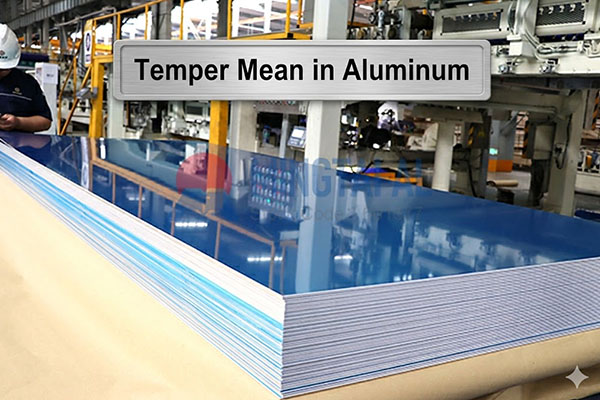
When people search temper mean in aluminum, they are usually trying to understand one thing: why the same aluminum alloy can behave so differently in forming, bending, or strength. Temper is the condition of the metal after processing, and it has a direct impact on how the material performs in real applications.
A common mistake is to treat temper and alloy as the same thing. They are related, but they are not identical.
* Alloy tells you the chemical composition, such as 3003, 5052, or 6061.
* Temper tells you the physical condition of the material after processing.
* Together, they decide whether the sheet is easier to form, stronger in service, or more stable during fabrication.
That is why two materials with the same alloy number can still behave very differently if their temper is not the same.
Temper affects several practical factors that matter during production and use:
1. Formability — whether the material can be bent, stamped, or drawn without cracking.
2. Strength — whether the final part can hold its shape and perform reliably.
3. Stability — whether the material keeps consistent performance from batch to batch.
4. Surface behavior — whether it works well for visible parts or further finishing.
For many projects, temper is the detail that decides whether a material is simply “available” or actually suitable.
These three tempers are often compared because they appear in many common aluminum applications.
H14
H14 is a work-hardened temper that gives a balanced mix of strength and formability. It is often chosen when a part needs moderate strength but still has to be shaped during fabrication. It is a practical option for applications where neither extreme softness nor extreme hardness is ideal.
H32
H32 is also work-hardened, but it has been stabilized to improve consistency. In many cases, it is selected when the material must keep more predictable performance during processing and use. If a project needs a more controlled temper condition, H32 is often worth reviewing.
H112
H112 is generally used as a basic condition after hot working. It is not usually the final answer for every application, but it is useful when further forming or downstream processing is expected. It gives engineers and fabricators a starting point that can fit different production routes.
This is where temper becomes more than a technical term. The right choice only makes sense when it is paired with the right alloy.
For example:
* 3003 is often used for general forming and good workability.
* 5052 is widely chosen for better strength and corrosion resistance.
* 6061 is commonly selected for structural parts and applications that need higher performance.
The same temper can behave differently across these alloys. A temper that works well in one alloy may not give the same result in another. That is why alloy selection and temper selection should be reviewed together, not separately.
For internal product planning, this also creates a useful structure for linking related alloy pages. A page about temper can naturally connect to 3003, 5052, or 6061 material pages without feeling forced.
If the goal is to narrow down the right material condition, start with the final use:
* Need easier forming or bending? Look for a temper that supports better ductility.
* Need more strength and shape retention? Compare harder conditions.
* Need a steady, predictable condition for production? Review stabilized tempers like H32.
* Need a starting point for further processing? H112 may be suitable depending on the alloy and thickness.
This simple logic helps turn a technical term into a useful purchasing decision.
A few points are often overlooked:
* Temper is not the alloy number.
* Harder does not always mean better.
* A temper that works for one product may fail in another.
* Thickness, forming method, and final application can change the best choice.
In other words, temper should never be chosen from the code alone.
Mingtai Aluminum’s support
Mingtai Aluminum supplies aluminum materials with consistent quality and reliable temper control for industrial use. If you are comparing alloy and temper options, our related product pages can help you match the right material to your project needs.
What does temper mean in aluminum?
It refers to the condition of aluminum after processing, which affects strength, formability, and stability.
Is temper the same as alloy?
No. Alloy describes composition, while temper describes material condition.
Which is better, H14 or H32?
Neither is universally better. H14 and H32 serve different needs depending on forming, strength, and stability requirements.
Can the same alloy have different tempers?
Yes. The same alloy can be supplied in different tempers, and each one will perform differently.