Stock code: 601677
Stock code: 601677
Electromagnetic interference (EMI) is a common challenge in electronic device design. Sources of interference come from inside the equipment—power supplies, clock signals, high‑speed data lines—and from the outside—wireless signals, lightning, and industrial machinery.
If EMI is not properly controlled, devices may suffer from signal distortion, data errors, or even functional failure.
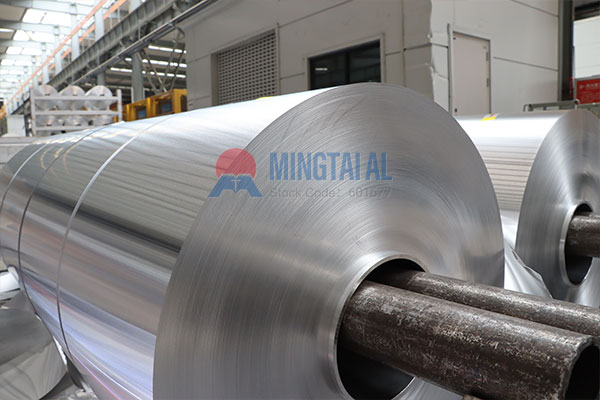
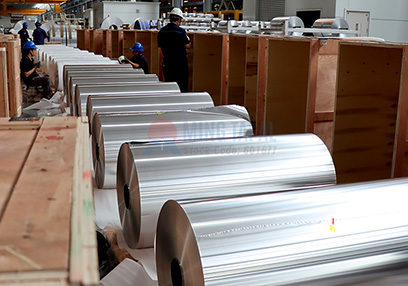
1235 H18 Aluminum Foil is a proven solution. It offers good conductivity, low weight, and cost‑effectiveness, making it widely used in shielding applications.
The 1235 alloy contains no less than 99.35% aluminium, placing it in the high‑purity category. Higher purity means fewer electron scattering events, which translates to stable electrical conductivity.
Impurity levels are tightly controlled: silicon plus iron stays below 0.65%, and copper below 0.05%. This provides a solid material basis for electromagnetic shielding.
H18 denotes a fully hard temper, achieved through cold working to reach the highest strength level.
For this grade, tensile strength typically reaches ≥135 MPa (and can exceed 150 N/mm² at 0.07 mm thickness).
Why does this matter? In applications like shielding tapes and cable wrapping, the foil needs sufficient rigidity to maintain structural integrity during processing, application, and transport. The H18 temper delivers exactly that.
The shielding capability of aluminium foil comes down to one key property: electrical conductivity.
When electromagnetic waves hit the foil surface, free electrons in the aluminium rearrange themselves, generating an induced field that opposes the external field. This is the essence of the Faraday cage effect.
In practice, shielding occurs through three mechanisms:
– Reflection loss – waves are reflected at the foil surface
– Absorption loss – some energy is dissipated within the foil
– Skin effect – at higher frequencies, waves tend to travel near the surface, reducing penetration depth
In simple terms, the higher the frequency, the more effective the foil becomes.
A practical reference: below 1 GHz, interference sources struggle to penetrate foil thicker than 38 μm.
1. Shielding Tapes (Foil Tapes)
This is the most direct use of this alloy and temper in electronics.
The tape is made by coating the aluminium foil with a pressure‑sensitive adhesive. The H18 temper provides the mechanical strength needed for clean cutting, conformability, and durability during use.
Typical end‑devices include transformers, mobile phones, computers, PDAs, PDPs, LED displays, laptops, copiers, and many other electronic products that require EMI shielding.
2. Cable Shielding Layers
Cable shielding is a traditional and strong application for this foil. The foil is wrapped around the cable core—either longitudinally or helically—to form a continuous conductive shield.
Key advantages of this alloy in cables:
– Effectively blocks internal EMI and prevents external fields from interfering
– Low density (2.7 g/cm³) significantly reduces cable weight compared to copper (8.96 g/cm³)
– Good flexibility, suitable for high‑speed automated wrapping processes
– Self‑forming oxide layer provides corrosion resistance without extra coating
With the growth of 5G, this foil is now used in 5G communication cables, high‑frequency data cables, and RF cables, typically in thicknesses ranging from 0.05 to 0.10 mm.
3. Lithium‑Battery Current Collectors
In lithium batteries, this foil serves as the positive electrode current collector. It collects and conducts current, ensuring normal battery operation. This application also relies on the high conductivity and mechanical strength of the H18 temper.
Thickness Selection
Thickness directly affects shielding effectiveness and process compatibility.
Available thicknesses start from 20 μm and above, covering the mainstream needs of electronics shielding. General guidelines:
|
Thickness Range |
Typical Use |
|
20–30 μm |
Shielding tapes, general EMI shielding |
|
30–50 μm |
Cable shielding, standard EMI protection |
|
50 μm and above |
High‑frequency cables, 5G communication cable shielding |
H18 vs. O Temper – Which to Choose?
– H18 (hard) – higher strength and stiffness, ideal for tape substrates and cable wrapping where mechanical support is needed
– O (soft) – better ductility, suited for deep‑drawing and complex forming processes
For shielding tapes and cable shielding, H18 is the more common choice.
Width and Length
Width is typically adjustable from 100 to 1700 mm, and length can be customised to order.
Q: What frequency range is this foil best suited for?
A: It is especially effective against high‑frequency EMI; below 1 GHz, interference hardly passes through 38 μm foil.
Q: What is the minimum thickness available?
A: We supply thicknesses from 20 μm upward, covering the full range needed for electronics shielding.
Q: How does H18 differ from O temper for shielding?
A: H18 offers greater strength and rigidity for tape and cable applications; O temper is softer and better for forming operations.
*Henan Mingtai Al supplies reliable 1235 H18 Aluminum Foil with customisable thickness (20 μm and above) and width. Reach out to discuss your shielding requirements.*