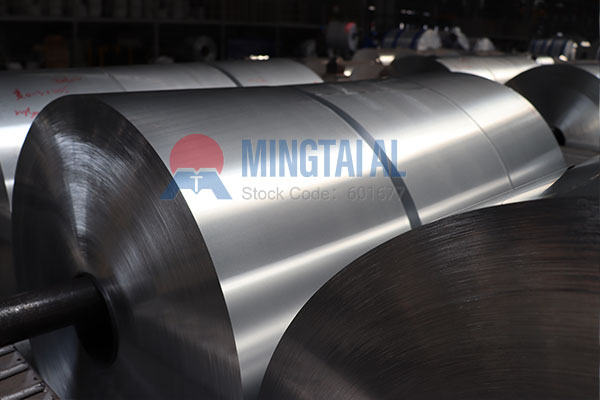
Stock code: 601677
Stock code: 601677
When a cable must carry signals cleanly and remain stable over time, the shielding layer is not a minor detail. 1235-O aluminum foil is often selected for this layer because it combines high purity, soft temper, and dependable conductivity. In cable construction, it is commonly formed into an aluminum-plastic composite tape and wrapped around the core as a protective shield. The result is a cleaner signal path and better protection for the insulation and conductor.
Aluminum foil is common in cable tape because it provides a tight barrier and effective electromagnetic shielding. It works like a flexible shield around the cable core, helping signals stay clean and stable.
Its main roles are:
– Electromagnetic shielding: The foil forms a continuous metal layer that reflects and absorbs electromagnetic waves, reducing interference inside and outside the cable.
– Moisture and water blocking: Dense aluminum foil resists water vapor, helping protect insulation from dampness and conductors from oxidation.
– Mechanical protection and structure: The foil wrap helps hold stranded conductors in place and cushions external pressure during bending, pulling, and installation.
– Grounding protection: The shield can act as a grounding path, allowing fault current to pass safely and helping protection devices respond.
Each role supports the others. A continuous shield improves signal quality. A dry core protects insulation. A stable wrap keeps the shield in place. A safe grounding path reduces risk if a fault occurs.
1235 aluminum is a high-purity grade, typically with aluminum content of 99.35% or higher. The O temper is fully annealed, which makes the foil soft and ductile. Compared with hard-temper foil, it stretches more easily and bends without cracking.
This matters during cable production. The foil must follow the cable as it bends and forms. A stiff foil can crack or break at the fold, creating a gap in the shield. 1235-O aluminum foil forms smoothly, overlaps cleanly, and resists pinholes during longitudinal wrapping or overlapping. It also maintains stable conductivity, so the shield performs as intended.
Cable foil is not limited to one alloy. Common choices include:
– 1235-O foil
– 8011-O foil
– 1060 and 1100 aluminum foil in certain designs
Thickness usually falls in the 0.1–0.2 mm range. Width is often customized to the cable structure, with common production covering 100–1650 mm. The final choice depends on the cable design, wrapping method, line speed, and lamination process.
Chemical Composition
For 1235 foil, aluminum content is typically 99.35% or higher. Silicon, iron, copper, and other impurities must be controlled. Too much impurity lowers conductivity and makes the foil more brittle. An unbalanced iron-to-silicon ratio can also increase surface pinholes. Strict composition control helps maintain both conductivity and formability.
Thickness, Width, and Tolerances
Cable foil is commonly produced in thicknesses from 0.1 mm to 0.2 mm. Width is set by the cable design. Thickness tolerance is important because uneven thickness can cause inconsistent wrapping tension and weak spots. Width tolerance helps keep the overlap stable, so the shield does not leave gaps.
Mechanical Properties
The key properties are tensile strength and elongation after break. The foil should have relatively low tensile strength and high elongation, so it can wrap and bend without breaking. Coils should also have neat edges, no turned edges, and stable running on high-speed wrapping machines.
Pinholes and Surface Quality
Pinholes are one of the most important defects in cable foil. Large pinholes are not acceptable. Thin foil must keep pinholes at a very low level because they break the continuity of the shield and reduce moisture protection.
The surface should be clean, with no oil, dust, corrosion spots, scratches, or wrinkles. Residual oil can weaken later lamination with plastic film. Surface particles can press holes into the foil during wrapping.
Shape and Coil Quality
The coil should be flat, without waves or loose and tight edges. Coil tightness should be uniform, the core should be strong enough, and unwinding tension should remain stable. Poor shape can cause bulging and wrinkles during longitudinal wrapping, which may interrupt the shield.
Other Service Requirements
Cable foil also needs stable conductivity. The surface oxide film should be uniform so the foil does not discolor easily during storage. The material should handle normal cable operating temperatures without becoming brittle or cracking. For composite foil, the aluminum-to-plastic bond must also be strong enough for the intended lamination process.
Q: What does “O” mean in 1235-O aluminum foil?
A: It means the foil is fully annealed and supplied in a soft temper.
Q: Why is 1235-O aluminum foil often used for cable shielding?
A: It bends without cracking and keeps stable conductivity.
Q: Can it be laminated with plastic film?
A: Yes, it is commonly used in aluminum-plastic composite tape.
Q: What surface defects should be avoided?
A: Oil, dust, corrosion spots, scratches, and wrinkles should be avoided.
Q: Is 8011-O a suitable alternative?
A: Yes, 8011-O is also common when the cable design allows it.
Before ordering, confirm the alloy and temper, thickness and width, mechanical properties, pinhole standard, surface cleanliness, coil dimensions, and lamination compatibility. These details decide how well the foil will run on the line and how reliably the shield will perform in service.
For cable foil supply, Mingtai Aluminum Industry produces this grade with full-process quality control from melting and rolling to annealing and slitting. It can support customized coil sizes and material selection for stable cable shielding production.