Stock code: 601677
Stock code: 601677
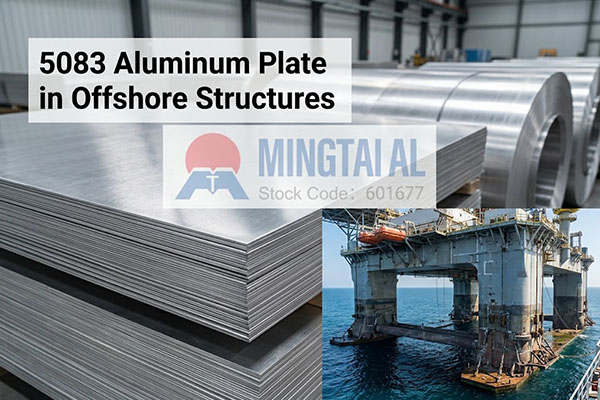
Offshore platforms, ship decks, LNG storage tanks – these structures face constant salt spray, wave impact, and low temperatures. Choose the wrong material, and you end up with frequent maintenance or even structural failure. 5083 Aluminum Plate in Offshore Structures has proven to be the go-to solution for these extreme conditions.
Chloride ions in seawater are like a slow poison to metals. Ordinary steel loses about 0.1–0.5 mm of thickness every year due to corrosion in the ocean. And you have to keep repainting it – that maintenance cost alone can eat up 15–20% of the steel structure’s initial investment.
There’s also the weight problem. Steel is heavy, which means more expensive foundations and harder installation. And in Arctic or deep‑sea work, low‑temperature brittleness becomes a real danger.
1. Naturally resistant to seawater corrosion
5083 is an Al‑Mg alloy with magnesium content tightly controlled between 4.0% and 4.9%. When exposed to air, it naturally forms a dense oxide film that blocks chloride ions like armor. Even if that film gets scratched, it “heals” instantly.
Test data: 5083 plate lasts over 8,000 hours in salt‑spray tests without perforation. It passes both ASTM G66 and G67 corrosion tests, and it resists intergranular and exfoliation corrosion much better than 5052.
2. Lighter weight, lower life‑cycle cost
5083 has a density of about 2.68 g/cm³ – only one‑third that of steel. Yet its tensile strength reaches 290‑350 MPa, giving it a specific strength close to steel.
Replace steel with 5083, and your platform becomes lighter. Foundation loads drop, stability improves, and – most importantly – you almost eliminate anti‑corrosion maintenance. Over a 25‑year life cycle, maintenance savings can reach 40‑60% compared to steel.
3. Reliable weldability
Offshore structures demand long welds. 5083 supports MIG and TIG welding; 5356 filler wire (slightly higher magnesium) is recommended. Weld strength can reach over 90% of the base metal. The H116 and H116 tempers are specially designed for welding – the stabilisation treatment removes the risk of intergranular corrosion in the heat‑affected zone.
4. Excellent low‑temperature toughness
At ‑196°C, 5083 still keeps outstanding elongation and impact toughness. Ordinary steel becomes as brittle as glass at that temperature. That’s why LNG tanks, liquid oxygen pipelines, and Arctic offshore structures rely on it.
Major classification societies – CCS, ABS, BV, LR– all recognise 5083 as an approved material for marine applications.
Certification covers three things:
– Strictly controlled chemistry (Mg 4.0‑4.9%, Fe ≤0.40%, Cu ≤0.10%)
– Mechanical properties that meet the standards (tensile, yield, elongation)
– Approved welding procedures (X‑ray inspection and fatigue testing)
Without classification society certification, you cannot use the plate in formal offshore engineering projects.
Both tempers work for marine applications, but their best uses differ:
|
Temper |
Core feature |
Typical application |
|
5083-H116 |
Optimised for seawater corrosion resistance, designed for long‑term immersion |
Hull outer plates, parts constantly in seawater |
|
5083-H321 |
Extra stabilisation heat treatment; better dimensional stability under high temperature and cyclic loads |
Heavy‑duty decks, load‑bearing structures |
In short: use H116 for hull shells, and H321 for decks and structural members that carry loads.
When selecting 5083 Aluminum Plate in Offshore Structures, always check the temper against your actual working conditions.
|
Material |
Strength (MPa) |
Density (g/cm³) |
Seawater corrosion resistance |
Life‑cycle cost |
|
5083 Al |
290‑350 |
2.68 |
Excellent |
High value |
|
5052 Al |
210‑260 |
2.68 |
Good |
Suitable for light duty |
|
Carbon steel A36 |
400‑550 |
7.85 |
Poor (needs coating) |
Low initial, high maintenance |
– Offshore platform decks – uses the high strength, natural corrosion resistance, and anti‑slip tread of 5083 for safety and weight saving.
– Ship hull structures – outer plates, bulkheads, and other seawater‑exposed parts directly resist corrosion.
– LNG storage tanks – stays tough at ‑196°C, making it the core material for cryogenic storage and transport.
– Auxiliary components – handrails, brackets, piping systems – covering almost every need.
When your offshore project calls for reliable 5083 plate, Mingtai Aluminum holds full classification society certifications and has proven delivery experience – a supplier worth considering.
Q1: 5083 or 5052 for marine use?
A1: Choose 5083 for harsh, high-strength environments and 5052 for general use with cost sensitivity.
Q2: H116 vs H321?
A2: H116 prioritizes seawater corrosion resistance for hulls; H321 ensures dimensional stability for heavy decks.
Q3: Does 5083 become brittle at low temperatures?
A3: No, it stays tough down to -196°C, ideal for LNG and Arctic projects.
Q4: Does 5083 need extra anti-corrosion coating?
A4: No, its natural oxide film provides seawater protection.
Q5: How important is classification society certification?
A5: Essential – without it, you cannot enter formal offshore projects.
Q6: How weldable is 5083?
A6: Very good; use 5356 filler wire for weld strength >90% of base metal.
Q7: Main advantage of 5083 on offshore platform decks?
A7: High strength, corrosion resistance, light weight, and anti-slip tread reduce deck load and improve safety.
Q8: Available thicknesses?
A8: 3–200 mm, with 6–50 mm for hulls and 2–6 mm for interiors and piping.