Stock code: 601677
Stock code: 601677
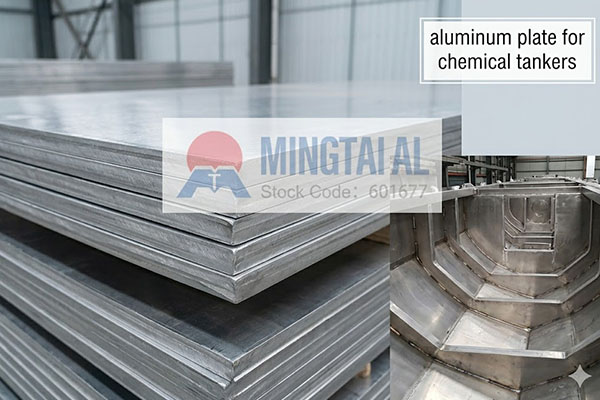
Chemical tankers carry a wide range of cargoes—petroleum products, industrial chemicals, food-grade liquids—each placing different demands on tank materials. The ideal solution must resist corrosion, reduce deadweight, offer reliable weldability, and maintain structural integrity over decades of service. Aluminum plate for chemical tankers has emerged as the industry’s preferred answer to these challenges, delivering performance that steel simply cannot match. This guide walks procurement professionals and technical teams through the essential considerations: alloy selection, dimensional specifications, and the certifications that matter.
Aluminum’s dominance in chemical tanker construction rests on three pillars.
The Lightweight Advantage
With a density roughly one-third that of steel, aluminum plates dramatically reduce tanker deadweight. The payoff is immediate: greater payload capacity per voyage and measurably lower fuel consumption. For fleet operators, these efficiency gains translate directly into improved operating margins.
Superior Corrosion Resistance
5000-series aluminum-magnesium alloys naturally develop a dense, self-repairing oxide film on their surface. Even if scratched, the film reforms, maintaining a continuous barrier against corrosive media. In salt-laden marine environments, aluminum significantly outlasts ordinary carbon steel, with tank service lives extending well beyond what steel can offer.
Excellent Weldability
Both 5083 and 5454 alloys weld readily with dedicated filler wires (such as 5356 or 5183), achieving weld joint strength coefficients at a high percentage of base material performance. Weld zones retain robust corrosion resistance and strength—critical for complex tank structures subjected to cyclic loading and thermal stress.
The two workhorse alloys for chemical tankers are 5083 and 5454. Both belong to the Al-Mg family of non-heat-treatable alloys, but each serves distinct operating conditions.
|
Aspect |
5083 |
5454 |
|
Primary Strength |
Exceptional resistance to seawater corrosion; excellent low-temperature toughness |
Superior heat tolerance; maintains stress-corrosion cracking resistance at elevated temperatures |
|
Ideal For |
Standard chemical tankers, hull structures, cryogenic service |
Hot asphalt, emulsions, and medium-to-high temperature cargoes |
|
Selection Rule |
The default choice for most applications |
Preferred when cargo temperatures are elevated (typically from moderate up to around 150°C) |
In short, choose 5083 for routine chemical transport; switch to 5454 when thermal stability is a priority.
Thickness Guidelines
Tank plates generally range from a few millimeters up to around a dozen millimeters. Hull bodies and load-bearing sections require greater thickness for pressure integrity, while baffles and partitions can be thinner to save weight without compromising safety.
Width and Length Options
Standard widths span from one meter to over two and a half meters, with lengths customized per order. Wide plates are especially valuable—they reduce the number of longitudinal welds, improving both structural continuity and leak-tightness.
Temper Selection – What Each Letter Means
Choosing the right temper is just as important as choosing the right alloy:
– O (Annealed) – Maximum formability; ideal for tank heads, partitions, and other components requiring bending or complex shaping.
– H111 – Moderate strength with good workability; suited for tank bodies and other pressure-retaining parts.
– H116 – Marine-grade temper with stringent corrosion-control requirements; excellent resistance to exfoliation corrosion; specified for hull exteriors and decks in direct contact with seawater.
– H321 – High-strength, stable condition; used in heavy-load structural applications.
Aluminum plates bound for chemical tankers must clear multiple regulatory and classification hurdles. For procurement teams, verifying these credentials is not optional—it is the foundation of safe and compliant vessel operation.
– Material Standards – Compliance with ASTM B209, EN 485, or equivalent specifications is mandatory.
– Classification Society Approvals – Certifications from major societies such as CCS (China), ABS (USA), BV (France), and LR (UK) are the industry benchmark.
– Industry Codes – The IMO’s International Code for the Construction and Equipment of Ships Carrying Dangerous Chemicals in Bulk (IBC Code) sets out detailed requirements for tank construction.
Always request and verify the supplier’s certification documentation before placing an order.
Global demand for marine aluminum plate continues its upward trajectory, driven by three powerful trends: expanding international chemicals trade, intensifying pressure on shipowners to improve fuel economy and reduce emissions, and tightening environmental regulations that favor lightweight, recyclable materials. Aluminum—infinitely recyclable without loss of properties—is uniquely positioned to benefit from these shifts, pointing to a bright future for aluminum tanker construction.
Choosing the right material for chemical tanker tanks means balancing alloy grade (5083 or 5454), temper (O, H111, H116, or H321), dimensional specifications, and certification status. A well-informed selection delivers safety, regulatory compliance, and superior lifecycle economics. For projects where performance and longevity matter, aluminum plate for chemical tankers continues to set the standard.
Mingtai Aluminum supplies marine-certified 5083 and 5454 plates with approvals from CCS, ABS, BV, and LR, available in custom sizes up to 2650mm in width.
Q1: Which alloy is most common for chemical tankers?
A: 5083 is the top choice for most applications; 5454 is better for high-temperature cargoes.
Q2: What thickness range is typical for tank plates?
A: From a few millimeters up to about 12–15 mm, with thicker plates for the tank body and thinner for baffles.
Q3: Does aluminum tank plate need surface coating?
A: No – the natural oxide layer provides full corrosion protection.
Q4: What certifications are required?
A: ASTM B209 or EN 485 compliance, plus approval from CCS, , ABS, BV, or LR.
Q5: How much lighter is aluminum than steel?
A: Aluminum has about one-third the density of steel, significantly reducing overall tank weight.