Stock code: 601677
Stock code: 601677
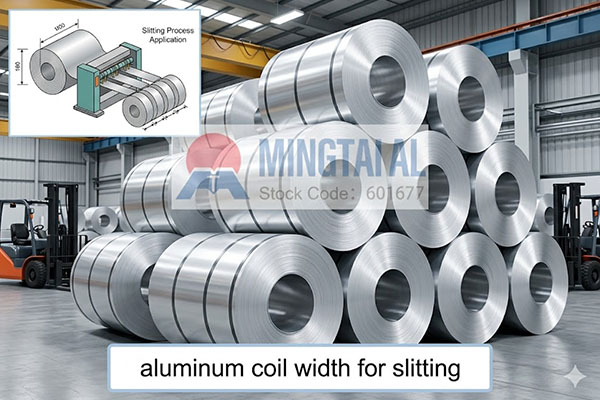
Choosing the right aluminum coil width for slitting is the first decision that affects scrap rate, equipment compatibility, and final strip accuracy. Many buyers guess the width, then end up with narrow bands that are either too wide or too narrow. This guide gives you a three-step calculation method to get it right every time.
Start by answering two questions: How many narrow strips do you need? What is the exact width of each strip in millimeters? Add all strip widths together to get the total net width.
Example: You need 6 strips – 150mm, 150mm, 200mm, 200mm, 200mm, 300mm. Total net width = 1200mm.
But this is only the ideal number. Real slitting requires adding three waste factors:
– Slitting kerf loss: Each cut uses 2–5mm of material (depends on blade thickness). For 6 strips you need 5 cuts. If one kerf takes 3mm, that’s 15mm total.
– Edge trimming: Leave 5–15mm on each side to remove burrs and irregular edges. Soft alloys (O temper, H2x) need 10–15mm per side. Hard alloys can use less. For this example, take 10mm per side → 20mm total.
So the master coil width you need = 1200 + 15 + 20 = 1235mm.
Formula to remember:
*Master coil width = (sum of strip widths) + (number of cuts × kerf loss) + left trim + right trim*
Your calculated width must fit your slitting machine. Check three limits:
– Maximum and minimum master coil width the slitter can handle
– Arbor length (usually 50–100mm longer than max coil width for safe loading)
– Minimum strip width the slitter can produce
If 1235mm exceeds your machine’s max width, you need a narrower master coil or a different slitter. If it’s far below the minimum width, the arbor will be poorly utilized and uneconomical.
Common aluminum coil width ranges (market standard)
|
Application |
Typical width (mm) |
Most economical sizes |
|
Roofing, wall panels |
1000–1250 |
1000, 1200 |
|
HVAC foil, cable wrap |
800–1200 |
1000, 1100 |
|
General industrial strips |
1200–1500 |
1250, 1500 |
|
Wide curtain wall, can end |
1500–2000 |
1600, 2000 |
Always prefer these common widths. Non-standard sizes cost more and take longer to deliver.
Many people forget tolerance. ASTM B209 gives two levels: standard ±3mm, precision ±1.5mm or even ±1.0mm. When you slit a coil, any width variation in the master coil transfers directly to every narrow strip. If your strip requires ±0.5mm tolerance, but your master coil has ±3mm tolerance, you will fail. Always specify “narrow tolerance” when ordering.
Alloy type also matters:
– Soft alloys (O, H22) – edges tend to wave during slitting. Add 3–5mm extra to each side trim.
– Hard alloys (H18, H19) – kerf loss can be smaller (blade as thin as 1.5mm), but edges are brittle. Do not trim too narrow.
– High strength alloys (5xxx, 6xxx) – shear stress can cause micro-cracks. Keep side trim at least 12mm.
You need 10 strips, each 100mm wide. Total net width = 1000mm. Number of cuts = 9. Kerf loss per cut = 2.5mm → total kerf loss = 22.5mm. Side trim: 8mm per side → 16mm. Master width = 1000 + 22.5 + 16 = 1038.5mm.
Common market sizes: 1040mm, 1050mm. If your supplier offers custom 1040mm, take it. If not, choose 1050mm and distribute the extra 11.5mm to side trims. This prevents narrow strips from becoming undersized.
– Forgetting kerf loss → every strip comes out too narrow. Entire coil wasted.
– Master coil wider than arbor length → cannot load the coil. Must re-slit or outsource.
– Too little side trim → burrs and waves cause >10% reject rate.
– Blindly ordering non-standard width → higher price, longer lead time. Choose 1250mm or 1500mm first, then adjust.
Determining the correct aluminum coil width for slitting comes down to three steps: calculate net demand plus waste, check equipment and market sizes, then confirm tolerance and alloy effects. Follow this process to cut scrap and improve slitting yield.
For precision slit-ready aluminum coils with consistent width tolerance, Mingtai Aluminum offers customized widths from 800mm to 2000mm. Just tell us your narrow strip sizes and we’ll deliver the exact master coil width you need.
Q1: What is the minimum side trim I can use for slitting?
A: For hard alloys with high precision, 3mm per side is possible; generally 5–15mm is safer for defect-free edges.
Q2: What is the most common aluminum coil width for slitting?
A: 1250mm and 1500mm, because they slit efficiently into many popular narrow strip sizes.
Q3: Can my slitter produce strips narrower than 100mm?
A: Most industrial slitters have a minimum of 20–50mm; ultra-narrow strips need special tooling.
Q4: Can a coil with ±3mm tolerance produce strips with ±0.5mm tolerance?
A: No. The master coil tolerance must be tighter than the strip tolerance. Order ±1.0mm precision coil instead.
Q5: What if my calculated width is not a standard size?
A: Ask your supplier for custom width (Mingtai Aluminum does this) or choose the next larger standard width and add more side trim.