Stock code: 601677
Stock code: 601677
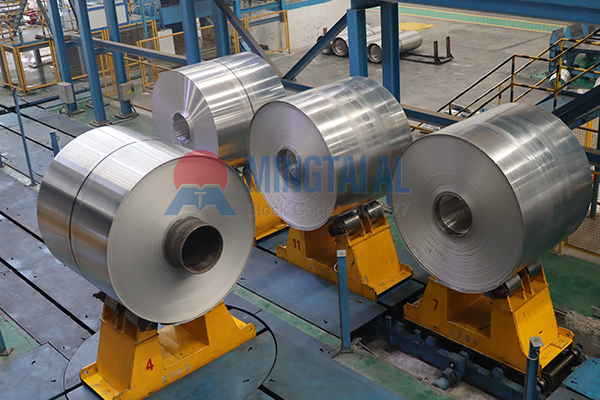
A key challenge in modern manufacturing is finding materials that are both light and strong. Vehicles need to reduce weight for better efficiency; machinery requires robustness to withstand high pressure. The aluminum coil with high tensile strength is the perfect solution to this dilemma. It maintains the inherent lightness of aluminum while offering load-bearing capacity close to some steels, making it a secret weapon for design upgrades across many industries.
Tensile strength simply measures a material’s resistance to being pulled apart. A higher value means the material is “tougher.” High tensile strength aluminum coil is engineered precisely for this purpose.
– Greater Load-Bearing Capacity: It can withstand heavier loads at thinner gauges, enabling lighter structures.
– Better Fatigue Resistance: It resists cracking under long-term vibration or repeated stress, leading to longer service life.
– Retained Workability: Compared to other high-strength metals, it can still be formed through bending or stamping.
The key lies in the alloy series and temper. Common series like 5xxx (e.g., 5083), 6xxx (e.g., 6061/T6), and 7xxx (e.g., 7075/T6) achieve significantly enhanced strength through processes like heat treatment.
This is not a lab material. It is widely used in these key sectors, solving real-world problems:
– Trucks & Tankers: Used for body panels and tank shells. The direct benefit is reduced tare weight, allowing more cargo per trip and boosting revenue.
– Special Vehicles: Serves as impact guards or chassis components. It ensures safety while optimizing vehicle weight distribution.
– Heavy Equipment Housings & Frames: Protects internal components from impact and deformation during operation.
– Robotic Arms & Conveyor Framing: Lightweight design enables faster movement and lower energy consumption, while high strength maintains long-term precision.
– Modular Buildings & Long-Span Roofs: Light weight eases transport and installation; high strength handles snow and wind loads safely.
The wrong choice can mean over-engineering (costly) or under-engineering (risky). Evaluate using these steps:
– What is the main force: tension, compression, or impact?
– Is the environment humid or corrosive?
– Is good weldability or bendability required?
– For Maximum Strength: Choose 7xxx series like 7075, common in aerospace and tooling.
– For Balanced Properties: 6xxx series like 6061 aluminum coil is the classic choice, offering a great mix of strength, workability, and corrosion resistance.
– For Excellent Weldability & Corrosion Resistance: 5xxx series like 5083 is ideal for marine or chemical environments.
– Mind the Temper: Tempers like “T6” (solution heat-treated and artificially aged) are essential for achieving high strength.
A sample approval doesn’t guarantee batch consistency. Always request an authoritative Mill Test Certificate (MTC) from your supplier. This report is the material’s “health certificate.” It lists the actual tested tensile strength, yield strength, and other data for that specific batch. It is the only reliable proof of quality.
Choosing the right high-strength coil is about selecting a reliable foundation for your project. As a manufacturer long-focused on aluminum coils, Mingtai Aluminum reliably supplies high-performance coils across these series. We provide the robust material starting point your demanding applications require.
Q1: What are the most common high-strength aluminum coil alloys?
A: 5083 offers great weldability and corrosion resistance. 6061/T6 provides the best all-around performance. 7075/T6 delivers the highest strength for critical applications.
Q2: Does welding weaken high-strength aluminum?
A: Yes, heat from welding can reduce strength in the affected area. Using the correct procedure is vital. The 5xxx series generally withstands welding better than the 6xxx or 7xxx series.
Q3: How do I verify the coil’s actual strength?
A: Always request the Mill Test Certificate (MTC). This official document lists the verified test results for your specific batch and is the true measure of its properties.
Q4: Should I prioritize thickness or strength?
A: Consider both together. A higher-strength alloy may allow you to use a thinner, lighter gauge to meet your design needs, which can optimize weight and cost.