Stock code: 601677
Stock code: 601677
The answer depends on the duty: 1060 aluminum strip for transformer winding can handle many low-to-medium-current busbar applications from an electrical standpoint, but its soft temper means joints and supports must be designed around aluminum behavior rather than copied from copper busbar practice. Mingtai Aluminum supplies 1060-O winding strip with conductivity guaranteed at ≥61.5% IACS—enough for routine distribution busbar duty—so the practical questions are how to install it and how it compares with alternatives.
Yes, with a clear distinction. In winding service, 1060 is normally supplied in O temper. Its conductivity typically sits in the 61–62% IACS range, with aluminum content above 99.6%, and its low strength and high elongation let the strip bend tightly and sit flush between layers.
In busbar service, that same conductivity level covers routine distribution, switchgear connections, and transformer lead busbars in the low-to-medium-current range. Against copper at equal ampacity, aluminum needs roughly 50% more cross-section, but it weighs about 40–50% less. The trade is real in both directions: you gain weight and cost advantages, and you pay with installation space.
This comparison decides whether 1060 is a practical fit or a poor match for a busbar project.
6101-T6 is a busbar-specific high-strength conductive alloy. Its conductivity is about 55–57% IACS, a few points below 1060, but its yield strength is several times higher, giving it much better creep and deformation resistance. 6061-T6 is stronger still, but its conductivity drops to roughly 40–45% IACS, which carries a larger energy-loss penalty.
So the choice is not about good versus bad aluminum. It is about which property matters most for your design:
– Choose 1060 when conductivity, cost, and low weight are the priorities, installation space allows a larger cross-section, and joints can be designed and controlled.
– Choose 6101 when the busbar must span longer distances, support itself, or survive vibration with fewer joint-maintenance concerns.
1060 is not a poor fit for busbar work. Its value is concentrated in low-to-medium-current, cost-sensitive, and weight-sensitive applications.
This is where practical experience matters most. Aluminum forms an insulating oxide layer almost immediately, so a bolted joint conducts only through the small points where that layer breaks. For soft 1060, the following steps matter:
1. Prepare the surface just before assembly. Remove the oxide layer with a dedicated stainless-steel brush or abrasive method, then assemble promptly so the oxide does not rebuild.
2. Use transition washers where copper meets aluminum. Serrated copper-aluminum transition washers bite through oxide on both sides and create a more stable contact without relying on conductive paste.
3. Prefer more small bolts over a few large ones. Multiple fasteners spread clamping force and are better suited to soft aluminum; pair them with thicker flat washers and a specified torque.
4. Include re-tightening in the maintenance schedule. Aluminum creeps under sustained clamping force—this is material behavior, not a defect. For vibration or frequent thermal cycling, a defined inspection interval costs far less than discovering a hot joint later.
The supply scope covers rolling and slitting only. Surface treatment or secondary processing of aluminum coil is not included and must be handled at the assembly stage.
– Do not default to O temper. Winding uses O temper for formability; a busbar joint in O temper has the least creep resistance. If one material must serve both roles, specify the temper separately—do not write only “1060.”
– Confirm conductivity and cross-section together. A guaranteed minimum IACS is useful, but thickness tolerance on winding strip directly affects busbar current margin. Confirm both at the order stage.
– Confirm the joining method before ordering. Bolted, crimped, and welded joints place different demands on surface condition and temper. Early alignment avoids discovering a mismatch after delivery.
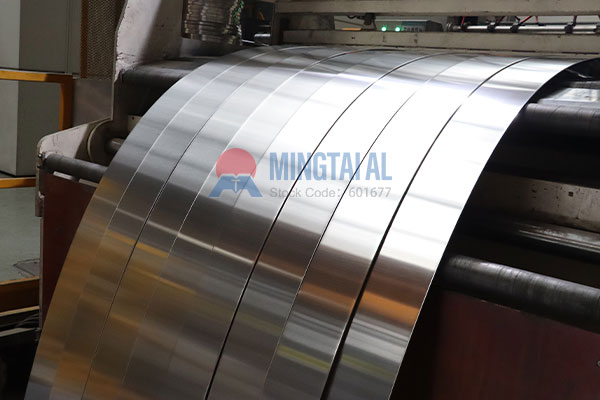
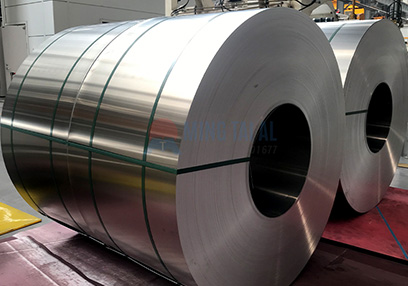
Mingtai Aluminum (mingtai al) supplies 1060 aluminum strip for transformer winding in O temper, with conductivity of ≥61.5% IACS, thickness from 0.08–3.0 mm, and width up to 1500 mm. Material is delivered in rolled and slit form for direct use in winding or busbar processing.
Q: Can 1060 winding strip be used for busbars without design changes?
A: Electrically it can suit many low-to-medium-current cases, but soft-temper joints need surface preparation, transition washers, and controlled torque.
Q: What is the main difference between 1060 and 6101 for busbars?
A: 1060 offers higher conductivity and lower cost, while 6101 offers much higher strength and creep resistance.
Q: What is the most overlooked step in a 1060 busbar bolted joint?
A: The most overlooked step is removing the insulating oxide layer immediately before assembly.
Q: Is a 1060 aluminum busbar lighter than copper at equal ampacity?
A: Yes, but it needs roughly 50% more cross-section, so installation space matters.
Q: Can O-temper 1060 be used in bolted busbar joints?
A: It can, but O temper has the weakest creep resistance and needs a denser bolt layout, thicker washers, and a defined re-tightening interval.
Q: Does Mingtai supply 1060 in tempers beyond O for busbar use?
A: Mingtai supplies rolled and slit 1060 strip, and temper selection and any surface treatment should be confirmed against the final application before ordering.