Stock code: 601677
Stock code: 601677
In the global industrial materials market, bare aluminum sheet (untreated aluminum substrate) has become a core raw material in industries such as construction, automotive manufacturing, and electronics due to its lightweight properties, corrosion resistance, and workability. However, significant variations exist in the quality, performance, and suitability of bare aluminum sheet supplied by different vendors. For buyers, how can precise questions help identify high-quality products? This article analyzes six critical questions across three dimensions: material composition, production processes, and application suitability.
The performance of bare aluminum sheet is rooted in its alloy composition. Common 1000 series (e.g., 1100 pure aluminum) offers high ductility but low strength, making it suitable for decorative applications. The 5000 series (e.g., 5052 aluminum-magnesium alloy) provides strong corrosion resistance, often used in marine and humid environments. The 6000 series (e.g., 6061 aluminum-magnesium-silicon alloy) achieves higher hardness through heat treatment, making it ideal for structural components. Buyers must clarify their needs: for building facades, the 6000 series ensures wind resistance, while food packaging requires compliance with hygiene standards.
The internal quality of bare aluminum sheet depends on melting and rolling processes. Reputable suppliers use high-purity aluminum ingots and employ electromagnetic stirring to minimize composition segregation. During rolling, multi-pass cold rolling combined with online leveling equipment ensures minimal thickness tolerance. Poor process control may lead to coarse grains or uneven thickness, affecting machining accuracy.
Key questions: Is inert gas protection used during melting? Does the rolling mill meet international precision standards?
Tensile strength (maximum stress before fracture) and elongation (deformation capacity before breaking) are core mechanical indicators. For example, automotive body panels require balanced strength and formability, favoring the 5000 series, while heat sinks prioritize thermal conductivity, making the 6000 series more suitable.
Key questions: Can third-party mechanical performance test reports be provided? Is small-batch sample testing available?
Many buyers overlook the impact of cutting on material utilization. Top suppliers use laser cutting or high-precision shearing to ensure burr-free, distortion-free edges. Tension control systems during slitting prevent warping, reducing material waste. Poor precision may cause installation gaps or structural weaknesses.
Key questions: Are cutting machines equipped with automatic deviation correction? Can slitting width tolerance be kept within ±0.1mm?
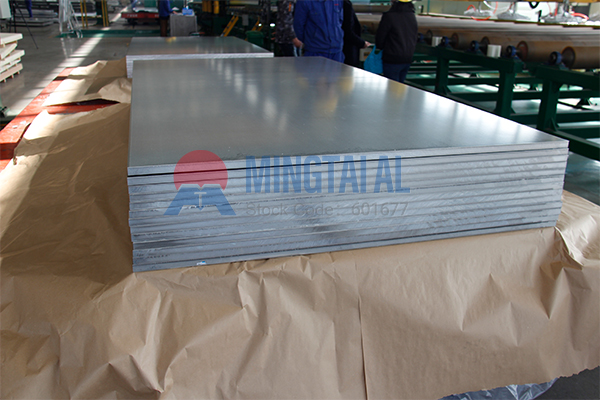
As a leader in China’s aluminum processing industry, Henan Mingtai Aluminum has specialized in bare aluminum sheet production for over two decades, offering a full range of alloys from 1000 to 6000 series. With German-made rolling mills and intelligent melting systems, Mingtai’s products excel in thickness tolerance, flatness, and internal uniformity. Its flexible production line supports customized solutions, from alloy adjustments to precision cutting. Whether for construction, automotive, or electronics, Mingtai provides end-to-end support to reduce overall costs.
When purchasing bare aluminum sheet, buyers should move beyond “price-first” thinking and focus on material-process-application alignment. Using this question checklist to evaluate suppliers enhances decision-making and prevents costly rework due to material defects.