Stock code: 601677
Stock code: 601677
Choosing between five bar vs diamond aluminum tread plate for flooring may seem like a minor detail, but the pattern affects slip direction, cleaning effort, and how well the material fits your project. The wrong choice can leave a floor with weak grip in one direction or add unnecessary maintenance. Use the guide below to compare them for your flooring application.
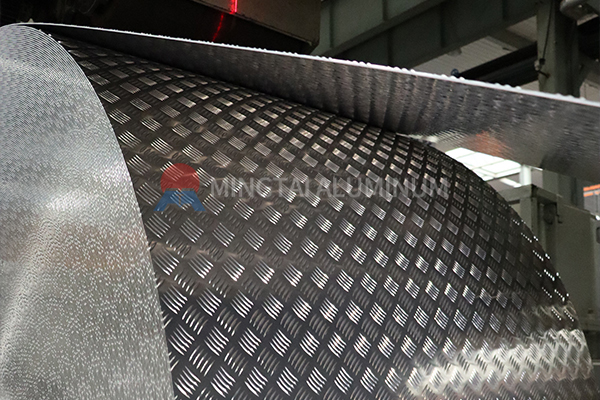
Five bar has parallel ribs arranged in groups, giving the texture a clear direction. It grips best perpendicular to the ribs. This makes it suitable for ramps, stair treads, and loading areas where movement follows a fixed path.
Diamond has raised shapes spread evenly across the surface, offering friction in multiple directions. It suits platforms, workshop floors, and general walkways where people move in different directions.
A simple way to decide:
1. Fixed traffic direction: choose five bar.
2. Multi-directional foot traffic: choose diamond.
3. Need both: five bar’s dense rib pattern tends to perform more evenly in real use.
Pattern alone does not determine load capacity. Thickness, alloy, and support span matter more. Consider them together.
– Decorative walls, light covers: low load, focus on flatness and appearance.
– Walkways, stair treads, equipment panels: standard flooring use, requires stable support.
– Truck floors, ramps, heavy platforms: high load, needs stronger alloy and thicker gauge.
– Heavy industrial structures: engineering assessment based on span.
At the same thickness, the two patterns perform similarly under load. Five bar’s closely spaced ribs help distribute compression, giving it a slight edge in stiffness.
Alloy choice is independent of pattern, but together they determine service life.
– 3003: general purpose, good formability, corrosion resistance, moderate cost.
– 5052: higher strength, excellent corrosion resistance, suitable for vehicles, outdoor use, and marine environments.
– 6061: high structural strength, suitable for heavy structures and machined parts.
Both patterns can be produced in these alloys. Surface treatment such as anodizing or painting is not part of our supply scope.
Regional preferences often point to one pattern:
– Five bar: More common in Asian and European markets. Its regular look suits vehicle trim, toolboxes, and marine decking.
– Diamond: More traditional in North America. Often linked with industrial style and classic anti-slip plate, used for pickup bed liners and decorative walls.
Naming can also differ. Five bar is sometimes called checker plate, while diamond is often called diamond plate. A drawing or reference sample during inquiry helps avoid confusion caused by these naming differences.
The two patterns differ in how easy they are to clean:
– Diamond: Wider spacing between raised shapes creates a more open surface. Sweeping, washing, and drainage are easier.
– Five bar: Denser ribs can trap dust and oil in the gaps, so it may need more frequent cleaning. For food processing and commercial kitchens, diamond is often the more practical choice.
Both patterns use an aluminum base that is naturally corrosion resistant. Routine care with a mild neutral cleaner and a soft cloth is usually enough.
Choose five bar if your project is:
– A factory floor with oil, water, and complex traffic paths.
– A ramp or stair tread needing maximum grip perpendicular to travel.
– A truck bed or container floor.
– An order for European or Asian markets.
Choose diamond if your project is:
– A pickup bed liner or toolbox panel.
– A decorative wall, kick plate, or bar front.
– A project for the North American market.
– A place where cleaning ease matters, such as a kitchen or food workshop.
If both work, follow market convention and drawing requirements. In export projects, five bar is often the default option.
Whether you are comparing five bar vs diamond aluminum tread plate for a specific flooring project, Mingtai Aluminum supplies both patterns in alloys such as 3003, 5052, and 5754, with specifications customized to project needs. Contact us for selection support and a quotation.
Q: Which pattern costs more, five bar or diamond aluminum tread plate?
A: Five bar usually costs slightly more because its deeper embossing is more complex to produce.
Q: Can both patterns be mixed in one project?
A: Yes, but switch them by functional zone to avoid sudden changes in the same traffic area.
Q: Does aluminum tread plate need extra surface treatment?
A: Most environments do not require it; special needs can be arranged separately.