Stock code: 601677
Stock code: 601677
Selecting the right aluminum coil for roll forming is the first and most important decision for any continuous production line. Surface quality directly determines the final product’s value. Scratches—even minor ones—can ruin appearance and lead to rejected batches. Many problems trace back to material selection, while others emerge during the forming process itself. This guide helps you choose the most suitable coil and build an effective scratch‑prevention system from delivery to finished parts.
Getting the alloy and temper right is non‑negotiable. These two choices affect formability, strength, and corrosion resistance.
Common alloys for roll forming:
– 3003 / 3105 – The workhorses. They balance strength and formability well, making them ideal for roofing, siding, gutters, and wall panels.
– 5052 – Choose this when your product needs superior corrosion resistance, such as for coastal environments.
– 1050 / 1060 – Pure aluminium series. Excellent formability, but lower strength. Best for deep‑drawn parts or decorative items with less structural demand.
Temper matters equally:
– O temper (fully annealed) – softest, best for complex shapes.
– H14 / H24 (half‑hard) – the most common choice for roll forming, giving a good mix of strength and ductility.
– H18 (full‑hard) – high strength but limited formability; use with caution.
> This article focuses on the base aluminium coil itself, not on coatings or surface finishing.
To prevent scratches, you need to know their root causes. In practice, they originate from three main areas:
1. Coil defects – A quality coil should be free from visible dents, roller marks, or obvious scratches. This depends entirely on the supplier’s process control.
2. Line equipment issues – Dirty rollers, misaligned guides, and accumulated aluminium particles are the top culprits. Even a small particle on a roller can create a continuous scratch along the entire length.
3. Handling and storage mistakes – Using metal slings during unloading or failing to separate coils with protective layers can cause irreversible damage before the coil even reaches your line.
Your best defence starts at the receiving dock. A few simple checks can save hours of rework later.
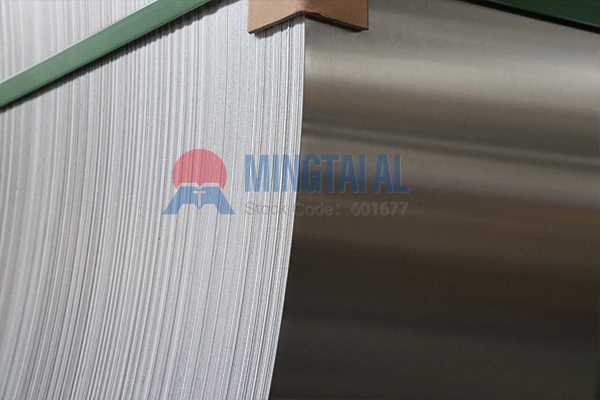
– Visual inspection – Unroll a short section under good lighting. Look for scratches, dents, roller marks, or oil stains. A good coil surface should be clean and flat.
– Thickness measurement – Use a micrometer at multiple points. Tight thickness tolerances keep roller gaps stable and reduce abnormal friction.
– Packaging condition – Check if the coil is tightly wrapped with moisture‑proof materials and if inter‑layer protection (like paper or plastic) is in place to prevent transit scratches.
Even the best coil will suffer if your line is not clean and well‑maintained. Invest in prevention – it costs far less than sorting or scrapping finished parts.
– Clean rollers regularly – Set a schedule to remove built‑up aluminium dust and oil residue, especially after downtime.
– Inspect guides and side rails – Make sure they are smooth, aligned, and free from wear. Misaligned guides rub against the strip edge and create continuous marks.
– Choose appropriate roller materials – Polished rollers (e.g., Cr12 or GCr15) reduce friction. Chrome‑plated rollers also help minimise particle adhesion.
Once the coil arrives, how you store and move it is just as critical.
– Use non‑metallic slings – Always use nylon or polyester lifting straps. Never let metal chains or hooks touch the coil surface.
– Separate coils – Place wooden or cardboard dividers between stacked coils to prevent pressure marks and rubbing.
– Control temperature and humidity – Keep your warehouse well‑ventilated and dry. Avoid large temperature swings that can cause condensation, which may lead to water stains or corrosion.
Before putting the coil into production, take a few minutes to perform these hands‑on checks. They help you confirm that the aluminum coil for roll forming you receive meets your expectations for surface integrity.
– Flatness test – Unroll a section and lay it flat on the floor. Look for waves, buckles, or curvature (camber).
– Hand feel – Wearing clean gloves, gently run your palm over the surface. Feel for any fine particles, bumps, or uneven spots.
– Bend test (practical reference) – Cut a small sample and bend it. The resistance should match the stated temper. Also check the bend area for cracks – this gives you indirect feedback on material uniformity.
Q1: Which alloy is most common for roll‑formed building products?
A: 3003 and 3105 are the most widely used because they offer a strong balance of formability and strength.
Q2: How can I tell if a scratch came from shipping or from my line?
A: Shipping scratches are usually random and irregular, while line‑related scratches tend to be continuous and evenly spaced along the strip length.
Q3: What is the practical difference between H14 and H24 temper?
A: H14 is strain‑hardened without annealing; H24 is strain‑hardened and then partially annealed – both have similar hardness, but H24 offers slightly better formability.
Q4: Does packaging really affect scratch prevention?
A: Yes – good packaging uses anti‑scratch interleaving paper, moisture barriers, and tight strapping to protect the coil throughout transit and storage.
For a reliable source of consistent‑quality aluminium substrates that support efficient, continuous roll forming, Mingtai Aluminum supplies a broad range of alloys and tempers with precise tolerance control and full material test certificates.