Stock code: 601677
Stock code: 601677
In numerous industrial manufacturing, architectural, and product development projects, engineers, purchasers, and decision-makers often face a fundamental yet critical choice: should they use aluminum coil or aluminum sheet? While they may seem to differ only in form, this choice directly impacts production efficiency, cost structure, and final product quality. This article provides an in-depth analysis of the core differences, aluminum coil vs sheet pros and cons, and their respective applications to help you make the optimal decision.
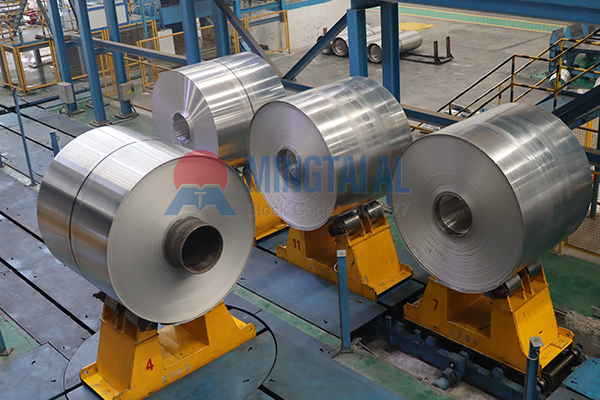
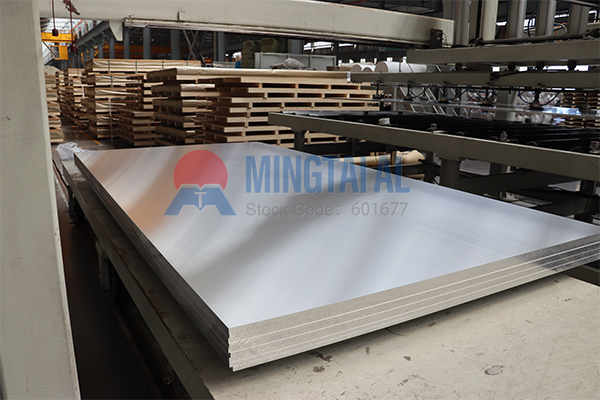
Aluminum coil is continuously rolled and wound onto a steel mandrel for transport and storage. Aluminum sheet is sheared or saw-cut into fixed-size flat pieces (e.g., 1m×2m, 1.22m×2.44m).
This fundamental difference in form creates a chain reaction. Coil is typically thinner (common range 0.2-6.0mm, thicker custom options exist) and suited for continuous processing. Sheet has a broader thickness range (from 0.3mm thin gauge to over 200mm ultra-thick plate) and is ideal for piece-by-piece work. Understanding this is the starting point for a correct selection.
– High Equipment Barrier: Requires investment in dedicated equipment like decoilers and levelers (entry-level investment ~$15k-$45k), unsuitable for small-scale or temporary production.
– Stringent Storage Requirements: Must be stored upright, utilizing vertical space, and requires professional lifting tools (C-hooks) to prevent core damage.
– Low Flexibility: Switching specifications or alloys requires using up the entire coil, making it unsuitable for flexible, low-volume, high-mix production.
– R&D prototyping and small-batch trials.
– Custom, non-standard product manufacturing.
– Processing thick plates (>8mm).
– Production Efficiency Bottleneck: Single-sheet loading, positioning, and processing typically result in less than 70% effective working time, with higher labor cost proportion.
– Potential for More Waste: Irregular part nesting on single sheets can generate more scrap, leading to lower overall utilization compared to continuous coil processing.
– Cost Disadvantage at High Volume: When monthly usage exceeds 50 tons, total cost (considering purchase price, labor efficiency, and scrap rate) may become higher than a coil-based solution.
Evaluate your project needs based on these dimensions:
– Monthly Use > 50 tons, high product standardization → Strongly recommend evaluating coil.
– Monthly Use < 10 tons, high product variety → Sheet is typically more economical.
– In between → Requires detailed Total Cost of Ownership (TCO) calculation.
– Roll forming, continuous coating, high-speed stamping → Prioritize coil.
– Single-piece cutting, welding/assembly, engraving/etching → Sheet is more convenient.
– Existing or planned automated production line → Coil is the necessary choice.
– Limited equipment budget, using universal machine tools → Sheet is the practical starting point.
– Have heavy lifting equipment and vertical storage → Can manage coil storage requirements.
– Compact warehouse, frequent in/out traffic → Sheet has lower management complexity.
In aluminum processing, there is no universally “better” option, only the “more suitable” one. The core of your decision should not be limited to unit price comparison but involve a full-process cost analysis, considering equipment investment, labor efficiency, material utilization, and management complexity.
Whether you ultimately require high-quality aluminum coil or sheet, selecting raw material with precise composition, stable performance, and strict tolerances is the first line of defense for ensuring final product quality. Mingtai Aluminum, as an industry-leading supplier, provides a comprehensive range of aluminum coil and sheet raw materials in various alloys and tempers. Adhering strictly to ISO 9001 quality management systems, we ensure full traceability from chemical composition to mechanical properties, laying a solid foundation for your project’s success.
Q: What is the thinnest available aluminum coil and sheet?
A: In standard production, coil can reach 0.15mm (with specific alloys), while sheet typically starts at 0.3mm. For ultra-thin gauges, coil form is more stable for handling and processing.
Q: Can cut aluminum coil fully replace sheet?
A: Technically yes, but not always economical. Purchasing pre-cut sheets is usually better for small volumes. In-house coil cutting only saves cost with high, consistent usage and efficient nesting.
Q: Should a curtain wall project use coil or sheet?
A: It depends on the process. Factory prefabrication (batch production) favors coil for efficiency. On-site or custom single-piece work often uses sheet. The industry trend is toward prefabrication and coil.
Q: How to judge an aluminum supplier’s material quality?
A: Request three key documents: 1) Mill test certificate (chemistry/mechanical data), 2) Thickness tolerance report, and 3) Surface quality certification. Reliable suppliers like Mingtai Aluminum provide full traceability.