Stock code: 601677
Stock code: 601677
Aluminum sheet for automotive stamping follows a different set of rules when the part is a bracket rather than an outer body panel or a battery housing. Outer panels are judged by surface quality and hemming behavior; housings are judged by sealing and thermal performance. Brackets must form into shape across multiple bends and mounting faces, hold dimensions after springback, and stay reliable under vibration and load.
Aluminum has a lower elastic modulus than steel, so springback is more pronounced. Bracket precision therefore depends more on choosing the right alloy and temper than on forcing the die to compensate.
Moving a bracket from steel to aluminum is usually a lightweighting or corrosion-resistance decision. Once that is settled, the question becomes which aluminum family fits.
If stiffness or strength constraints are very tight and the shape is complex, balance formability against final performance. Do not default to the highest strength grade.
6xxx grades often look stronger on paper, but their higher yield strength makes the material flow less readily in the die. For a bracket whose first job is to form correctly, 5xxx grades are often the more practical starting point because they offer a wider forming window and are more forgiving in stamping.
– 5754-O — a forgiving baseline for complex brackets with multiple bends.
– 5182-O — slightly higher strength than 5754-O while keeping good forming ability; suitable for brackets that need some strength but still have complex shapes.
– 5052-H32 — higher strength with a narrower forming window; suited to simpler brackets dominated by bending and shallow stamping, especially where fatigue or load requirements are clear.
– 6061-T6 / 6082-T6 — high strength but lower tolerance for small-radius bending and large deformation, with cracking risk when bends are too severe. They enter bracket selection when load or stiffness is the first constraint, shape complexity is controlled, and the stamping side has springback compensation capability.
A single alloy can behave very differently once the temper changes. O temper is not simply softer; it brings a lower yield-to-tensile ratio and less springback, so the material flows more smoothly and the unloaded shape is easier to control. T6 temper raises strength, but it also raises the yield-to-tensile ratio, which makes springback compensation harder and die tuning more costly.
A simple rule: if the bracket includes deep drawing or large-angle hemming, O temper is usually the default starting point. If the work is mainly bending and shallow stamping with a clear strength requirement, then evaluate H32 or 6xxx-T4/T6.
An alloy quoted without a temper gives little basis for judging whether it will stamp well as a bracket.
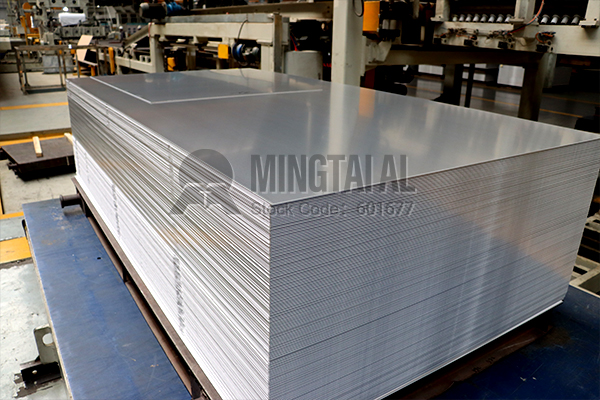
For aluminum sheet for automotive stamping, bracket yield problems often begin before the die design—in the physical and metallurgical condition of the incoming sheet.
– Thickness tolerance — variation affects effective die clearance. Thin areas tend to wrinkle; thick areas may crack or thin excessively.
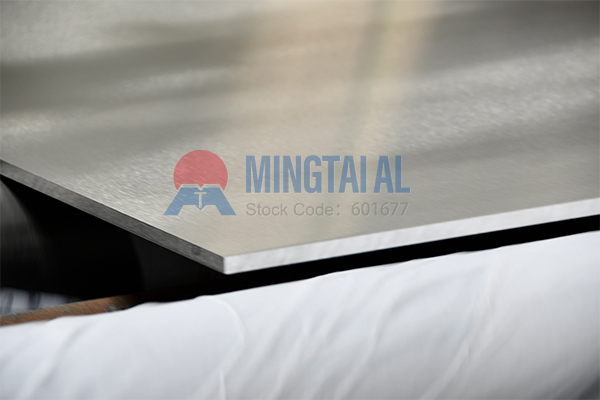
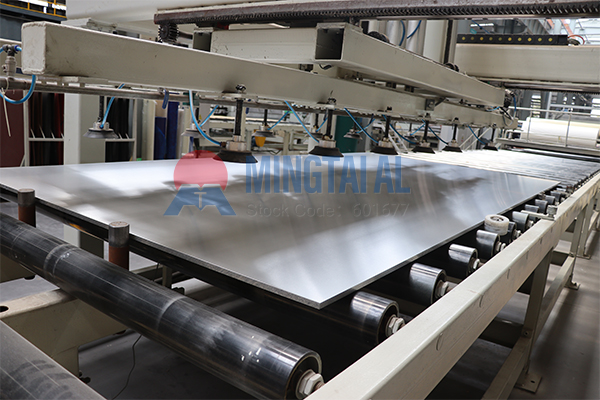
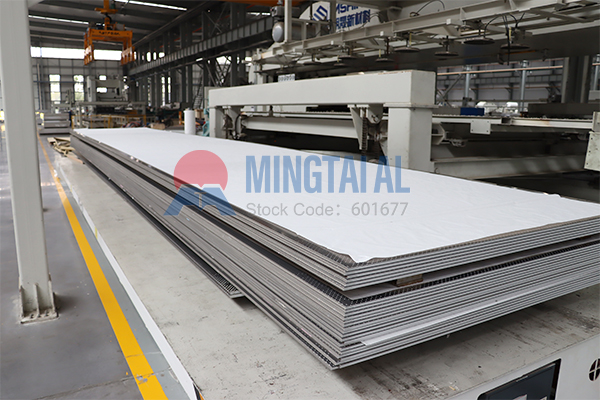
– Flatness and sheet shape — wavy edges or warp after uncoiling can disturb feed positioning and amplify dimensional spread in the bracket.
– Elongation and yield-to-tensile ratio — check these on the mill certificate alongside tensile strength. Elongation reflects bending and drawing capacity; the yield-to-tensile ratio indicates how hard springback will be to control.
– Mill certificate review — checking only tensile strength while ignoring yield strength and elongation gives an incomplete picture.
Stamping lubricants, oiling, and surface treatment of aluminum sheet or coil are process steps at the stamping stage. Mingtai supplies base material and does not provide surface treatment or re-processing of aluminum sheet or coil.
5xxx sheet can show streaky strain marks during stretch forming. These are related to alloy composition, grain condition, and deformation amount. Orange peel is a roughened texture that appears after forming when grains are coarse or uneven.
For brackets that will be painted or remain visible, either issue can affect acceptance. Annealing at the incoming-sheet stage can help control grain structure, but stamping parameters still need to work with the material.
Bracket stamping yield is the combined result of alloy, temper, incoming precision, and die compensation. The alloy grade alone is not enough.
1. Specify both alloy and temper — avoid writing only “5754 aluminum” or “6061 aluminum.”
2. Quantify thickness tolerance and flatness — separate general use from continuous-die or high-volume line requirements.
3. Check elongation and yield strength on the mill certificate, not just tensile strength.
4. Confirm that the incoming material is base sheet; stamping lubrication and surface preparation belong to the stamping stage.
5. Run a small trial before scaling up — especially when moving from steel to aluminum or switching alloy families. Validate die compensation with actual springback data.
Which aluminum alloy is most common for automotive bracket stamping?
5754-O and 5182-O are common starting points for forming-first brackets, 5052-H32 suits simpler brackets with higher strength needs, and 6xxx-T6 is selected only when load constraints are clear and springback compensation is available.
Does changing temper really change stamping results?
Yes, moving from O temper to H or T temper changes the yield-to-tensile ratio and elongation, which shifts springback behavior and the forming window.
Can stamping adjustments eliminate streaks or orange peel?
Incoming grain condition is the foundation; process parameters can reduce the symptoms, but unstable metallurgical condition is hard to solve from the stamping side alone.
Mingtai Aluminum supplies base material for automotive bracket stamping in 5754-O, 5182-O, 5052-H32, and 6xxx series, with alloy and temper matched to the bracket’s working conditions; thickness precision and flatness can be agreed around line requirements. For a specific bracket drawing, Mingtai Al can review incoming specification and temper fit and provide samples and technical alignment.